
Leeham News and Analysis
There's more to real news than a news release.


Updated with CEO comments: Air Asia orders for 150 A220s, giving program a big boost; launches high density version
By Scott Hamilton
May 6, 2026, © Leeham News: AirAsia and Airbus announced today that the low cost carrier placed an order for 150 A220-300s. This record-breaking order for the type previously capped out at 90 orders. (Delta Air Lines has placed orders for 145 A220s, but in several transactions.) More than 1,000 A220s have now been ordered.
This is key order for Airbus, which wants to increase production of the A220 to 14/mo. Before now, the backlog was far from supporting this production rate.
A high-density version of the airplane, which can seat 160 passengers, is under development. AirAsia is the launch customer for this version.

Related Article
- Airbus working on high density A220; ponders stretch model
- Airbus leans toward A220-500 but faces challenges
The state of alternative propulsion aircraft? Part 10.
Subscription required
By Bjorn Fehrm
May 6, 2026, © Leeham News: In our series on the state of alternative propulsion projects, we are looking at different hydrogen-fueled propulsion systems.
Hydrogen can either be processed chemically in a fuel cell to produce electrical power, which is then coupled to an electrical motor system, like for hybrids or battery electric aircraft. The advantage is that the system gets rid of the inefficient batteries that kill these systems.
The other alternative is to burn the hydrogen in the combustor of a gas turbine. The advantage is we keep the high power to mass ratio of a gas turbine with a heavier and more complicated fuel system, but a lighter fuel than Jet Fuel/SAF.
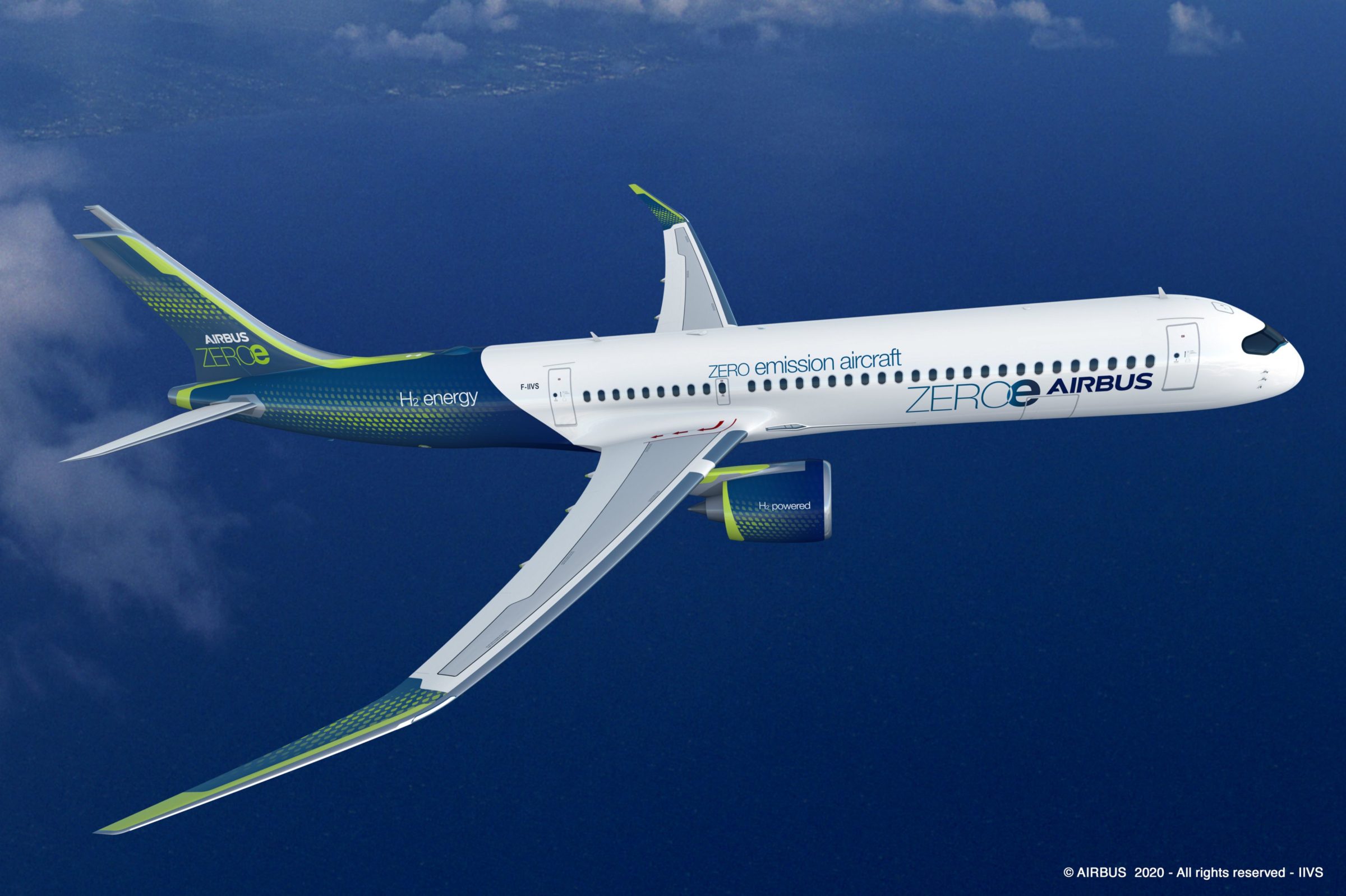
Figure 1. The hydrogen-burn airliner in Airbus’ ZEROe concepts. Source: Airbus.
Now we dive deeper into the gas turbine hydrogen burn variant.
Part 2: Solving Workforce shortages: Bumping Along or Soaring?
By Kathryn B. Creedy
Analysis
May 6, 2026, © Leeham News: The history of workforce issues is long–40 years–and dozens of efforts have attempted to address workforce shortages as we’ve bumped along, complaining about the problem and waiting for someone else to solve it.
Those involved in previous efforts warn that they failed because there was no accountability, and no one took responsibility for making things happen. They also cited the efforts staffed by volunteers. Now, our shortages are more acute than ever and threaten not only our economy but also our ability to grow.

Government studies often get shelved, gathering dust instead of solving the problem that study addressed. Credit: Bold Planning.
Over the past 40 years, Washington aviation/aerospace policy groups have focused on government solutions. After all, that is what they do, but it is time for a rethink. That is not to belittle the impressive accomplishments achieved when industry comes together, including workforce education grants and the robust education programs in FAA AvSED and NASA.
But if we do not act on our own, we will probably be having the same conversation decades from now. Instead, we could be leveraging the hundreds of great education programs already in place to solve our workforce issues once and for all.
Case in point of how we fail. It has been four years since the Congressionally mandated Youth Access to American Jobs in Aviation (YIATF) Report was issued, and nothing has been done, although private interests have been trying. It now sits gathering dust on some shelf. Ironically, we’ve seen this before, since the 2022 report was largely a repeat of the 20+-year-old Brewer Report. Nothing came of either effort.
Resources: This is Your Industry Speaking: By the Numbers: Workforce Shortfalls
May 6, 2026, (c) Leeham News: The following reports from Boeing, CAE, Oliver Wyman, Deloitte, PwC, and McKinsey provide much of the detail in our two-part series on the Aerospace and Defense Workforce. In addition, these reports may be summarized as follows:
 Boeing: 43,000 aircraft will be delivered between now and 2044. BUT: 56% of companies are struggling to hire skilled manufacturing workers, according to a study by AIA. “Both Boeing and Airbus have reported difficulties maintaining production schedules owing to a shortage of skilled workers, including machinists, welders, and chip engineers.” Boeing incurred an estimated $5bn in losses due to halted production and delays in plane deliveries. That begs the question of what the losses are across the industry, despite Boeing’s unique headwinds.
ARSA: The 2026 Global Fleet and MRO Market Report cited the industry’s top concerns were continuing threats posed by workforce shortages and the “juniority effect” despite the fact the MRO industry was reaching new heights.”
There’s the cost to safety.
“More than 5,000 companies employ nearly 430,000 people, each representing an average of $325,663 in revenue for the overall market,” said the ARSA/Oliver Wyman Vector report. “By 2027 — projected to be the worst year for the shortage — the bleakest scenario has the supply deficit at more than 48,000 aircraft maintenance workers, or a shortfall of about 27%. Our more likely scenario predicts a gap of almost 43,000, or more than 24%.”
The back of the envelope indicates if each of the 430,000 people in aviation maintenance produces an average of $325,663 in revenue, then the 12,000-18,000 shortage means we are failing to capture between $39.1tr and $58.6tr each year. If we had 43,000 more AMTs, that is roughly $14bn we are leaving on the table by not addressing workforce shortages in a wholesale industry-wide effort.
Part 1: Workforce Shortage Stunting Industry Growth, Costing Billions
Summary:
- This two-part series outlines the threat posed by workforce shortages to the future growth of aviation and aerospace, since industry-wide costs of workforce shortages are unquantified. Estimates suggest the industry is leaving tens of billions on the table as a result
- Technology alone cannot solve the problem as the workforce changes
- Current industry efforts to address the workforce are fragmented and, to elevate aviation/aerospace pathways and careers, must be coordinated with organizations delivering educational and career programs
- The solution is a collaborative, professionally managed Early-Learning-to-Career Pipeline leveraging existing programs and alliances to guide youth to aviation/aerospace careers
- Industry must pivot from relying on government to investing in organizing the army and educational and career assets we already have.
- Success requires industry-wide proactive collaboration, cultural change, and investment.
By Kathryn Creedy
May 5, 2026, © Leeham News: Not one of the numerous studies from every aviation/aerospace policy organization has quantified the costs of not addressing our workforce shortages at an industry-wide level, although concerns are rising at the academic level. And there is little effort in developing a unified career pipeline guiding the kids we are already inspiring into our careers, as other industries have long been doing.
Only a few estimates exist on the cost of workforce shortages:
- Aeronautical Repair Station Association (ARSA): Perhaps ~$14bn for the maintenance industry.
- Boston Consulting Group (BCG): Unavailable aircraft and MRO inefficiencies cost the industry $27bn annually.
- McKinsey & Co: Cost of Attrition for one medium-sized company is ~$300m–$330m
- International Air Transport Assn. (IATA)The additional cost borne by the airline industry from the supply chain was over $11bn in fuel and maintenance.
Aviation and aerospace policy groups in Washington, in their rush to convince policy leaders about the importance of their multi-billion-dollar impact on the economy, might be missing the forest for the trees in not quantifying the costs.

Raisbeck Aviation High School in Seattle is privately funded. Students study to become aerospace engineers. Credit: Raisbeck Aviation High School.
It is clear that the aviation, aerospace, and defense industries contribute billions to the economy, but two important facts are missing.
The total talent forecast for all segments of the industry and the cost of failing to meet workforce needs.
All studies cite rising compensation, higher maintenance, repair and overhaul (MRO) and manufacturing costs, and the costs associated with delays in returning aircraft from maintenance and in delivering new aircraft off the production line. But none quantifies how much those rising costs are.
Nor are they calculating the cost to safety, despite rising concerns over the loss of seasoned aviators and aviation maintenance technicians, and the resulting “juniority” on the flight deck and in the maintenance bay. Exacerbating our shortages is the training pipeline with a shortage of instructors, professors, and teachers.
Boeing’s Long Arc from Disciplined Rework to Distributed Chaos
Subscription Required
By the Leeham News Team
Part 1 of a five part series about Boeing’s path to recovery.
May 4, 2026, © Leeham News: From a 30-airplane cockpit rework crisis on the 767 to a supplier-driven configuration mystery on the 787, the history of Boeing’s pre-production change incorporation process is a master class in what happens when an industry’s best practices are forgotten in the name of financial engineering.
Getting it right the first time and avoiding time-consuming, costly rework are crucial for Boeing’s future airplane programs—and its long-term financial recovery.
In a previous article, LNA detailed “the high cost of getting it wrong.” We continue our in-depth exam of some of the fundamentals of Boeing’s path to recovery.
Related Story

The change incorporation events for the Boeing 767, 747-400, 777, and 787 are examined in the five-part Leeham News special report. Credit: Leeham News.
What Change Incorporation Actually Is—And Why It Is So Hard
When Boeing builds an entirely new type of airliner, the factory does not wait for regulators to complete their final review before rolling jets off the assembly line. Assembly of pre-production aircraft begins months or years before the FAA issues a type certificate.
There is a powerful economic logic driving this decision. A new commercial jet program represents an investment of billions of dollars. Every month that passes between the start of certification flight testing and the first revenue-generating delivery is a month of continued capital consumption with no return.
Airlines that signed purchase agreements are planning route networks, crew training schedules, and fleet retirements around contracted delivery dates. The manufacturer’s entire financial model for a new program depends on compressing the interval between first flight and first delivery to the greatest extent possible.
Reader Comments Open Forum, Week of May 4
 LNA’s Comments Open Forum allows Readers opportunities to comment about any post (note, we said “Post”, not any “Topic”). All comments will be held for review and Moderation per our new policy. The Open Forum enables Readers to Comment on paywall articles (to the extent the paywall preview is open to all readers).
Maintain civility and follow Reader Comment rules.
A new Open Forum will be posted weekly.
Change incorporation on Boeing 777-9s will take “years”, CEO said
Subscription Required
Open to All Readers
By Scott Hamilton
Background to a new series
 May 3, 2026, © Leeham News: Boeing has more than 30 777-9s built and stored at the Everett (WA) Paine Field, where the 777s are assembled.
Some have been stored since 2020. Years of testing, fixing, and certification delays pushed the anticipated delivery to next year. However, every stored aircraft must undergo change incorporation first to meet the standards required by the Federal Aviation Administration (FAA), which involves years of scrutiny, system updates, and fixes identified in testing.
Beginning tomorrow, LNA will publish a five-part series on incorporating change. Boeing has received a lot of publicity about this practice since the March 2019 grounding of the 737 MAX, the early 787s that were rife with design and production issues, and the suspension of 787 deliveries beginning in October 2020. These programs had unprecedented levels of change incorporation required.
However, the process isn’t new, and Boeing learned a lot over the decades. LNA describes the evolution of change incorporation since the Boeing 767 program. The 767 was originally designed as a three-crew cockpit. A few airplanes were produced in this configuration. After the FAA approved operation by two-person crews, Boeing had to change these airplanes from three- to two-person cockpits and change those in production.
LNA recounts change incorporation for the 767, 747-400, 777 Classic, 787, and the 777X.
CEO Kelly Ortberg, responding to a question on the 1Q2026 earnings call, gave a high-level outline of what Boeing faces with the 777X.
Bjorn’s Corner: Blended Wing Body Airliners. Part 8

By Bjorn Fehrm
May 1, 2026, ©. Leeham News: We are making a series of articles on the Blended Wing Body (BWB) as a potentially more efficient design for passenger-carrying airliners than the classical Tube-And-Wing (TAW) configuration.
In the seventh article last week, we discussed the structural difference between a BWB and a Tube-And-Wing aircraft. The classical aircraft has divided the cabin pressure problem, causing cyclic pressure stress on the cabin enclosure, by enclosing the cabin in an optimal closed-tube configuration, and the wings’ aerodynamic stresses from gusts, hard landings, and the possible engine-out case are managed by a one-piece wingbox from tip to tip of the wing. These loads differ in character and therefore use different structural concepts in tube and wing aircraft.
The BWB mixes these loads, where the cabin shape, being a wide and long box-like compartment, complicates the structural concepts, where fatigue-sensitive bending loads from the cabin pressure are hard to avoid. It’s not made easier by the wing loads being absorbed by the same structure.

Figure 1. The JetZero Z4 BWB. Source: JetZero.
Now we look at some BWB passenger-compartment challenges compared with TAW solutions.
MTU Aero Engines posts Q1 gains, sees continued strength despite geopolitical pressures
By Thomas Blackwood
April 30, 2026, © Leeham News: Operating profit and revenues at Germany’s MTU Aero Engines were up in the first quarter of 2026 amid a strengthening position across both the military and commercial divisions.
 Adjusted revenue was up 7% from €2.1 billion to €2.2 billion, while adjusted operating profit reached €320 million, 6% higher than in the first quarter of 2025 (€300 million).
The adjusted EBIT margin held steady at 14.2%, compared with 14.3% in the prior-year period, and adjusted net income grew by 3% from €221 million to €229 million.
The company confirmed its guidance for the full year and said that despite the uncertainty with the Iran conflict the board was “confident” it would reach the targets set, of full year adjusted revenue of between €9.2 billion and €9.7 billion, and adjusted EBIT of between €1.35 billion and €1.45 billion.