

Higher Fuel Costs Not Curbing Alaska Air Group’s International Ambitions
By Howard Hardee • Editor
September 28, 2026
Subscription Required
The trickle of oil escaping from the Strait of Hormuz and associated surge in jet fuel prices are unwelcome developments for all global airlines but come at an especially critical time for Alaska Air Group.
The airline company is in an early phase of an ambitious expansion plan, as it adds a host of international destinations and continues taking Boeing 787 Dreamliners to build a long-haul network out of Seattle. With longer flight stages comes greater fuel costs—on top of what is already the U.S. airline sector’s heaviest fuel-cost burden at baseline.
But the parent company of Alaska Airlines, Hawaiian Airlines and Horizon Air has no intentions of curbing its growth plan, according to Jason Berry, Alaska’s chief operating officer. He addressed still-elevated fuel prices at the Aerospace Futures Alliance’s annual conference in Seattle on September 24.

Alaska Airlines takes its inagural flight from Seattle with an international livery taxis ahead of first flight to Tokyo in January 2026. Photo credit: Wikimedia Commons
Asked by Leeham News and Analysis (LNA) whether Alaska Air Group has been forced to adjust its long-haul expansion or consider earlier-than-expected aircraft retirements, Berry said that rising fuel costs “are a real thing and it’s a challenge.”
“It’s not just about this up-and-down of the volatility of the prices today,” he said. “We all pay that equally, but we also have a disadvantage here on the West Coast, where our fuel prices are typically much more expensive that where our competitors get their fuel from the Gulf and the East Coast. So, we’re working hard and diligently to find other ways to build resiliency into our fuel supply—not just from the current market, but for long term.”
Notably, Berry suggested that exploring alternative fuels, such as sustainable aviation fuel, becomes more urgent in a high fuel cost environment. In the shorter term, higher fuel costs are one of the scenarios the company’s management team plans for.
“We have a chicken and egg scenario here,” he said. “We could slow down and scale back, but we know we have huge growth ambitions, and we need to continue to carry forward. We’ll make some decisions on the fringes and on the edges where there’s opportunities. But the reality is that we need to grow. Growth is critical to our future and we’re going to continue to do that wisely.”
Soaring Fuel Prices Dim End-of-Year Outlook for Major U.S. Airlines
By Karl Sinclair • Contributing Writer
September 28, 2026
Subscription Required
Buckle up, folks. It’s going to be a bumpy ride.
Soaring fuel costs are squeezing already-thin airline margins, and the final quarter of 2026 projects to be a difficult period for U.S. carriers.

United Airlines is among major U.S. carriers feeling increasing pressure from rising jet fuel prices. Photo credit: Los Angeles International Airport
According to the IATA Jet Fuel Price Monitor, the global average for jet fuel is $194.65 per barrel, with U.S. operators paying $193.65 and Europe paying $207.56 for the week ending September 18.
At the end of 2024, jet fuel prices were in the $100 per barrel range.
The current average fuel price includes a crack spread of $67.14, which is the surcharge added at the refining level to “crack” the hydrocarbons into their useful components—gasoline, diesel, natural gas and mazut. In other words, these are refining costs.
Fuel is often an airline’s most-expensive line item, even in lower fuel cost environments, and it will surely be a top-of-mind discussion item when Delta Air Lines kicks off earnings season on October 9.
Read more
Bjorn’s Corner: Aircraft Structures, Part 20: Thermoplastic Composites
By Bjorn Fehrm • Aerospace Analyst
September 25, 2026
Over the last few weeks, we have looked at the most common aeronautical composite with a thermoset matrix and its many production methods. The alternative to a thermoset matrix is the thermoplastic matrix.
The reinforcing fibers stay the same (carbon, aramid/Kevlar, or fiberglass), but the thermoplastic matrix changes production methods significantly. In short, it gets more complicated, but thermoplastic composites remain increasingly attractive for aeronautical production.
It’s because of one key capability: thermoplastic composite parts can be welded together rather than fastened (i.e., bolted). Figure 1 shows the amount of fasteners used in joining the thermoset fuselage skins, frames, longerons, and sections of the Boeing 787 fuselage (Airbus A350 is no different) .

Figure 1. Fasteners used in joining the thermoset 787 fuselage. Picture credit: Boeing.
First GTF Advantage-Powered A321XLR Delivered to United
By Howard Hardee • Editor
September 24, 2026
U.S. enginemaker Pratt & Whitney has delivered the first GTF Advantage turbofan to an airline customer, marking what the company believes will be a turning point in the program’s history.
United Airlines recently took delivery of an Airbus A321XLR powered by a pair of the upgraded geared turbofans (GTFs), which P&W says will deliver improved thrust and fuel efficiency compared to present-day engines.
The Advantage engines feature a new hot section, with upgrades allowing for “up to twice the time on wing compared to today’s GTF engine,” P&W said.

P&W markets the GTF Advantage as capable of delivering 4-8% more takeoff thrust than present-generation GTF engines, “enabling longer range capability.” Photo credit: P&W
The company says the new units are “fully intermixable and interchangeable with today’s GTF engine model, simplifying operations for airlines like United that maintain combined fleets.”
How do Doubled Jet Fuel Prices Hit Airlines?
By Bjorn Fehrm • Aerospace Analyst
September 24, 2026
Subscription Required
Jet fuel prices have doubled since January, and analysts forecast we might not have seen the peak yet (Figure 1). The initial peak in April was because of the closure of the Strait of Hormuz. The escalation of the Middle East conflict to the entry of the Red Sea is driving the present price hike.
Figure 1 is based on a graph from the IATA jet fuel price monitor, which in turn is based on S&P Global Energy Platts’ market data. Jet fuel has consistently hovered around $90-$100 per barrel since the last hike in 2022, driven by Russia’s invasion of Ukraine, which pushed prices to a peak of $150 per barrel.

Figure 1. The IATA average and regional jet fuel prices based on S&P Platts’ market data. Photo credit: IATA.
Doubling jet fuel costs changes airlines’ operating costs. How much depends on what portion of operating costs depends on jet fuel. This, in turn, depends on the generation of aircraft. The latest generation of Airbus and Boeing narrowbodies lowered fuel costs by a nominal 15%, but this was largely offset by higher engine maintenance costs, narrowing the operational cost gap between older generations and today’s variants.
To understand the situation, we use the Leeham Aircraft Performance and Cost Model (APCM) to model the cost structure of both older and newer narrowbody and widebody fleets. We compare this with typical passenger and cargo yields to understand the effect on ticket and cargo prices if the jet fuel price hike stretches over time.
Automation Doesn’t Reduce ATC Workload. Not at First
By Vincent E. Bianco III • Contributing Writer
September 23, 2026
Subscription Required
New air traffic control automation increases controller workload before it reduces it, often for years. Having lived the last transition, I believe the FAA should judge CAP bidders not only on software performance, but on how they will staff, sequence, and manage the deployment.
On September 14, the Government Accountability Office (GAO) reported that the FAA is running its current modernization through 11,389 separate project schedules that nobody has joined into one. As a result, GAO found, the agency sends installation crews to the same facilities again and again, generally without arranging the visits to limit the disruption to controllers.
In one example, technicians are due at a St. Louis facility in April 2027 to prepare for a new voice switch. About eight months later, a different team is due at the same facility to prepare for new information displays.

The air traffic control tower at Los Angeles International Airport. Photo credit: LAX/X.com
Through both visits, the facility must continue handling live traffic.
That work marks the first phase of the FAA’s plan. The larger second phase includes the system five companies are now competing to build.
Read more
SPEEA’s Bargaining Units Recommend Approval for Two Boeing Contracts
By Scott Hamilton • Editor at Large
September 22, 2026
The Bargaining Unit Councils (BUCs) of SPEEA, the union representing Boeing’s engineers and technicians, recommended membership approval of two contracts offered by Boeing.

Boeing is still working toward steadying 737 production at a rate of 47 jets monthly at it facility in Renton, Washington. Photo credit: Wikimedia Commons
The first contracts were rejected in a vote last month. Both current contracts expire on October 6.
The BUCs, one for each group and contract, recommended approval late this afternoon. Voting for the new contracts begins on Thursday, continuing to noon on October 1. Vote results will be announced that afternoon.
Boeing and the union hope to avoid a strike that could interrupt Boeing’s financial recovery and production ramp-up to the rates in place on March 10, 2019: 52 per month for 737s and 12 a month for 787s. Currently, the company is seeking to stabilize at 47 737s per month and about nine 787s per month. Boeing has yet to achieve stability at that production rate for the 737s at the Renton plant.
Related Story
Korean Air’s Huge Boeing Order Shows How Far Ahead It Must Plan
By Jay Menon • Contributing Writer
September 21, 2026
Subscription Required
Korean Air will wait until the early 2030s for the first aircraft from its latest 103-aircraft Boeing order. The long lead time is not incidental to the deal. In fact, it is one of the reasons the airline is ordering now.
“Deliveries are scheduled to begin in the early 2030s. The order supports long-term network growth following the integration, while modernizing the fleet and mitigating industry-wide aircraft delivery delays,” a Korean Air spokesperson told Leeham News and Analysis (LNA).
The last part of that answer says a lot about the aircraft market that Korean Air is buying into.

Korean Air placed a “landmark” order for 50 Boeing widebodies in March 2025, in what turned out to be the beginning of a long-term fleet renewal strategy. Photo credit: Boeing
Boeing had 6,755 unfilled commercial aircraft orders at the end of August. That included 4,813 737s and 701 777s.
Korean Air is adding 50 737 Max 10s, 25 787-10s, 20 777-9s and eight 777-8 Freighters to that production queue.
For an airline fleet-planning into the next decade, identifying which aircraft to order and how to use them in its network are decisions separated by several years. Airlines are being forced to make educated guesses about the future.
Read more
Early Sentiment on Boeing’s Second Offer to SPEEA is Mixed
By Scott Hamilton • Editor at Large
September 21, 2026
Union members’ reaction to the second Tentative Agreement (TA) between SPEEA and Boeing is mixed on social media.
SPEEA is the Society of Professional Engineering Employees in Aerospace, representing engineers and technicians. Each group has a contract with Boeing, negotiated by SPEEA. The current contract expires October 6. The first TA, endorsed by negotiators on both sides of the bargaining table, was overwhelmingly rejected by both union groups, and both endorsed a strike if they don’t reach a new contract before midnight on October 6.

Following rejection of Boeing’s first contract offers, the union’s bargaining units meet this week to review new proposals. Photo credit: SPEEA
So far, comments on Facebook and Reddit by union members are mixed. This contrasts with nearly unanimously negative reactions to the first TA.
Not all members commenting on social media identify their affiliation. Those who do are overwhelmingly technicians.
The objections may be summarized as follows:
- Some members continue to compare the current contract offers unfavorably to the 2024 final contract agreed by the IAM 751.
- A few assert that Boeing merely moved money around in the current offers compared with the original ones that were rejected by wide margins.
- Some say the current offers don’t make up for wage stagnation vis-a-vis past inflation.
A few engineers wrote that they will vote “no” in solidarity with the technicians. One, who goes by the screen name MysteriousAffect3903, is representative.
“I’m a no vote to an almost yes, but still no. My concern is the techs still don’t seem happy, and I don’t want the profs [engineers] to vote yes and the techs no. I’m a prof, voting no out of solidarity. No one has to agree with this or my reasoning, just my take.”
Spirit’s ‘Goodwill’ and Questionable Contracts
By Karl Sinclair • Contributing Writer
September 18, 2026
Recent signs suggest reintegration of Spirit AeroSystems in Wichita, Kansas may not be proceeding in the smooth, orderly fashion that Boeing had hoped for. At least, not in the financial sense.
Recall that Boeing began talks to reacquire its former division in January 2024. At the time, both companies were facing intense scrutiny after a door-plug blew off a 737 Max 9 operated by Alaska Airlines shortly after taking off from Portland, Oregon.
Later that year, Spirit agreed to once again become part of the Boeing family for $4.7 billion in stock—in addition to the assumption of Spirit debt and a payment to Airbus in the $400 million range for taking over the Belfast, Northern Ireland wing plant, among other pieces of Spirit.
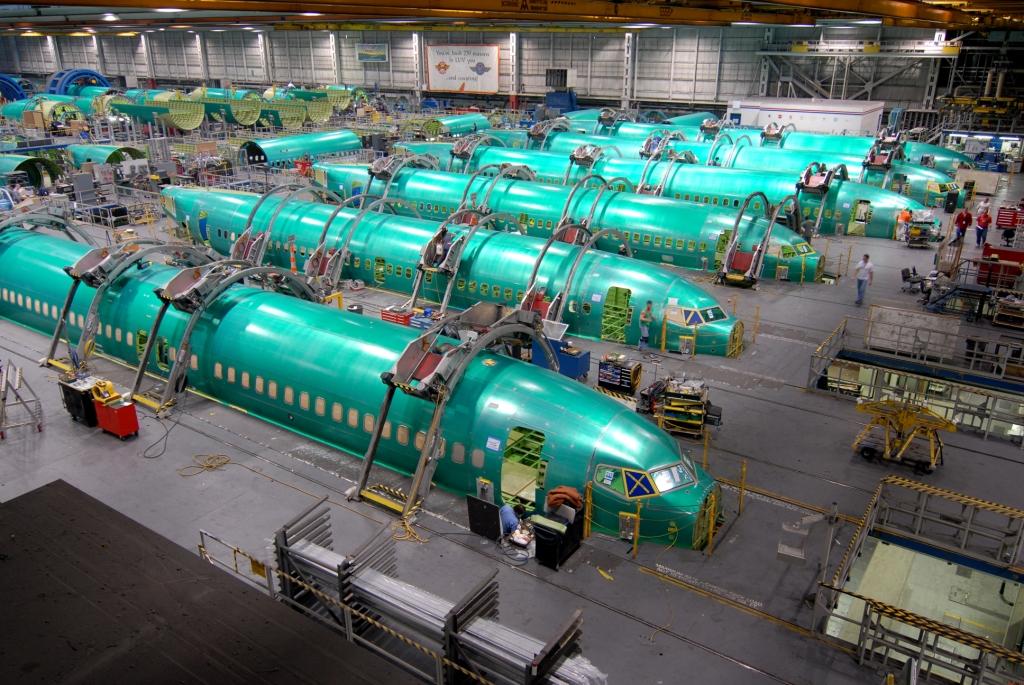
Boeing Wichita produces 737 fuselages and other major aerostructures for Boeing’s commercial programs. Photo credit: LNA Archives
Reintegration of both the Wichita facility and the financial entity has been choppy at times, despite reported workflow improvements on the factory floor and facilities upgrades. Leeham News and Analysis (LNA) reporting last month that traveled work represents an ongoing challenge for 737 fuselage production.
Now, additional liabilities uncovered by Boeing show that the company’s reintegration costs have risen to $10.3 billion, up from the initial $8.4 billion acquisition, according to the The Wall Street Journal (WSJ). Contracts signed between Boeing and Spirit prior to the reintegration effort appear to be the culprits.