
Leeham News and Analysis
There's more to real news than a news release.


Ortberg: 737MAX at 47/mo, target is 63/mo in the future
By Karl Sinclair

Boeing CEO Kelly Ortberg at the 737 production plant in Renton (WA). Credit: Boeing.
May 28, 2026, © Leeham News: “We’d like to get someday to 63 a month rate [on the 737 MAX], and so we’re looking forward to that. The market will support those higher rates. We’ve just got to get ourselves and our supply chain in a position to do that,” said Boeing CEO Kelly Orberg, speaking at the Bernstein Strategic Decisions Conference today.
Boeing recently completed a capstone review with the FAA and is producing at 47/mo in its Renton (WA) production facilities. Ortberg said it will take months to stabilize production at the new rate before seeking to boost it to 52/mo. This was the rate in March 2019 when the MAX was grounded by regulators following the second of two fatal crashes five months apart. The grounding would last 21 months.
However, in order to move beyond 52/mo, which Ortberg targets as the next review point, the North Line in Everett (WA) will have to be brought on line.
Previously, the Renton FAL had been able to produce at 57/mo, and was preparing to boost production to this rate when the grounding happened. Ortberg is no longer willing to push the facilities to that limit.
“We don’t think we can sustainably with our current safety and quality processes do that in Renton. That’s why we brought the additional line on. It’ll give us the capacity of an additional line. It also gives us flexibility,” he said.
GE’s LEAP engines shipped today should match durability of the venerable CFM56, company says
By Scott Hamilton
May 27, 2026, © Leeham News: GE Aerospace says that CFM International LEAP engines being shipped now will match the durability of the venerable CFM-56.
This was a goal promised when the LEAP first went on sale, competing with the Pratt & Whitney GTF in 2010. PW also promised durability comparable to that of the International Aero Engines V2500. The CFM56 powers the Boeing 737NG exclusively and shares power with the V2500 on the Airbus A320ceo. The LEAP-1A shares power with the GTF on the A320neo. The LEAP-1B exclusively powers the 737 MAX. The GTF entered service in December 2015, followed by the LEAP-1A shortly thereafter. The LEAP-1B entered service in May 2017.
Both engines fell well short of the guaranteed on-wing time.

GE Aerospace’s testing regimen to improve durability for its major engine programs. Credit: GE Aerospace.
Poorer durability than expected for both engines means parts failed or wore out more quickly than expected. Degraded parts also increased fuel consumption. Higher maintenance costs, in some cases significantly higher, offset double-digit fuel consumption savings each engine achieved. PW’s problems exploded into an industry-wide operating crisis as upwards of 700 A320neos, scores of Airbus A220s, and a handful of Embraer E195-E2 were grounded (aircraft on ground, or AOG) awaiting engine repairs or replacements.
Related Articles
CFM’s joint venture partners, GE and Safran, faced premature engine removals and a smattering of AOGs.
Airbus’ 27 year march to a new airplane
Subscription Required
Open to All Readers
By Scott Hamilton
Background
May 21, 2026, © Leeham News: We completed a multi-part series last month on Boeing’s 30-Year March to a New Airplane. Now, it’s Airbus’s turn.
It will be around 27 years between new airplane program launches, based on some moving targets.
The A350 was Airbus’ last all-new airplane design. (The A220 doesn’t count; this program was purchased from Bombardier.)

Figure 1. There is a plethora of new aircraft concepts and derivatives being discussed by various companies over the coming decade. Airbus has key decisions to make. Source: Leeham News.
In 2004, Airbus launched what would become the first version of the A350. It was an extreme makeover of the A330. Rolls-Royce Trent engines developed for the Boeing 787 were chosen for the new A350. A new composite wing replaced the A330’s metal wing. A few dozen A350s were sold, but it wasn’t long before Airbus realized this was going to be a loser.
After more false starts, Airbus launched the revamped A350 in 2006, called the XWB, for Xtra Wide Body. Since the A350 was Airbus’ response to the 787, the final version was slightly wider (hence the “Xtra Wide Body”), but narrower than the 777 fuselage. Airbus tried to straddle the 777 and 787 lines. The design was a compromise. LNA will discuss this further in our new series.
Airbus CEO Guillaume Faury previously said he expected to launch a new airplane program in 2030. This would follow about two years of testing the CFM RISE Open Fan engine, designed for the single-aisle replacements of the A320 and Boeing’s 737.
Engine testing was to begin in 2027. It now isn’t slated to begin until 2029. This means that a program launch is unlikely before 2031. That’s 27 years after the launch of the original A350. Whether 2004 or 2006 is the appropriate launch date, and if 2031 is good or a launch comes later, it’s still a long time between new airplane programs.
777X change incorporation will take years to complete; Boeing mum on details
Subscription Required
Open to all Readers
By Scott Hamilton and Karl Sinclair
May 19, 2026, © Leeham News: Boeing hopes to finally gain certification of the 777X in the coming months. Deliveries should begin next year, the company has repeatedly said.
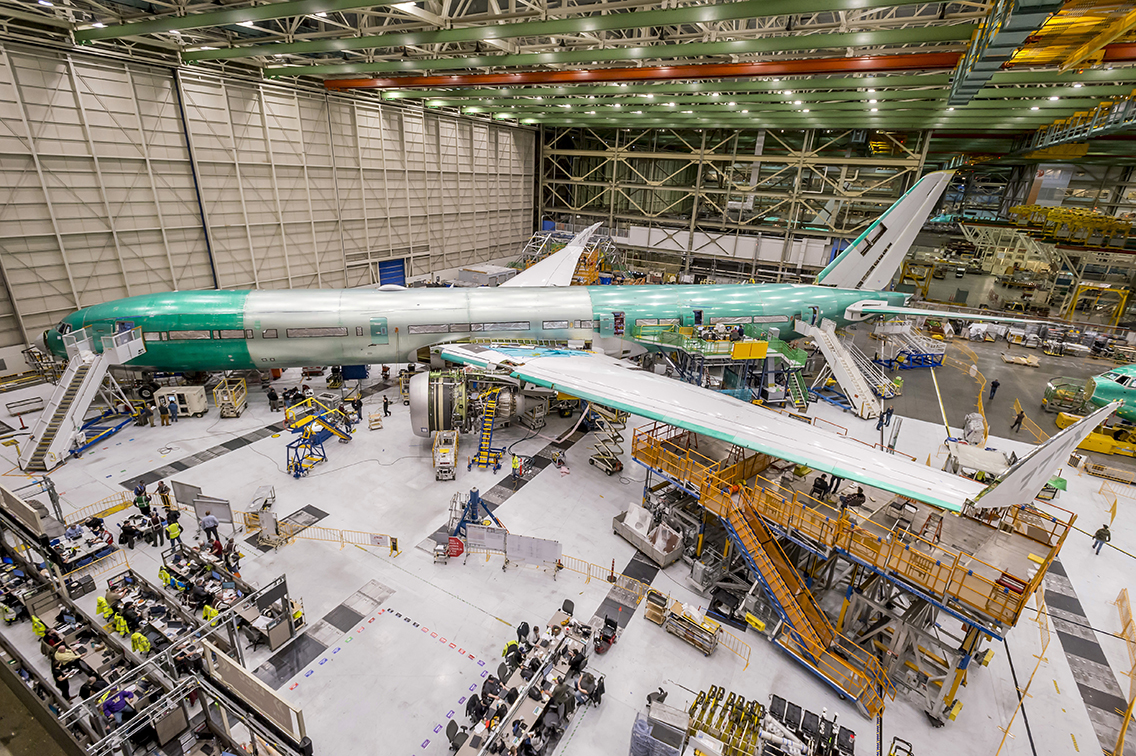
A Boeing 777-9 in final assembly at the Boeing plant in Everett (WA). Credit: Boeing.
On the 1Q2026 earnings call, CEO Kelly Ortberg said it will take years to complete the required change incorporation for an inventory of more than 30 777-9s. Some aircraft date to 2019 and have been stored since, while Boeing deals with a long, drawn-out certification process.
Ortberg said that “Change incorporation is basically for the airplanes that we have built. [We must] incorporate all the changes that have happened since they’ve been built. Things that result from the certification program, and things that happen as a result of productivity improvements or process improvements,” Ortberg said. “We go back in, and we incorporate all those changes before we make the delivery. It is a pretty massive activity that we have underway.”
Ortberg said that there is a dedicated team within BCA focused specifically on incorporating changes into the airplanes.
However, Boeing declines to detail the changes required, how long per airplane these might take, and whether customers intend to refuse delivery of these early airplanes.
LNA has learned that the first deliveries will likely be new production aircraft fresh off the final assembly line, rather than aircraft from inventory. The first production aircraft in testing is line #1781. According to the database Cirium, this is the 55th aircraft, for Lufthansa Airlines. Lufthansa was the first airline to order the 777X. Certification is expected late this year, with the first delivery next year. The first 777-9 was supposed to be delivered in 1Q2020, and perhaps in December 2019. The March 2019 grounding of the 737 MAX prompted the Federal Aviation Administration (FAA) to review the 777X certification program.
The 787: When the System That Makes Change Incorporation Possible was Dismantled
Subscription Required
By the Leeham News Team
The last in a Series examining one of Boeing’s steps toward recovery.
May 18, 2026, © Leeham News: The Boeing 787 program, launched in 2004 with a promised first flight in 2007 and customer delivery in 2008, was not simply a new airplane. It was a complete reimagining of how a commercial jet could be designed, funded, and manufactured.

Credit: Leeham News.
Boeing’s senior leadership, facing intense financial pressure and seeking to reduce its own capital exposure in a multi-billion-dollar development program, chose to distribute both the manufacturing and financial risks across a global supply chain of risk-sharing partners.

The level of industrial outsourcing on the 787 program led to one of corporate America’s greatest industrial financial and execution disasters. Credit: Seattle Times.
Suppliers would not merely provide components. They would design, build, and deliver complete major assemblies—entire fuselage sections, the wing structure, the empennage. The suppliers would absorb the tooling and development costs themselves in exchange for long-term production revenue.
Related Stories
- Change incorporation: the high cost of getting it wrong
- Boeing’s Long Arc from Disciplined Rework to Distributed Chaos
- The 767: A Cockpit Crisis Creates the Template
- The 747-400: Derivative Programs Apply the Lessons
- The 777: Art form at its peak
The economic logic was genuinely compelling. Boeing watched Airbus fund the A380 with European government launch aid while Boeing shouldered its own development costs.
Executives thought that the risk-sharing model promised to drastically reduce Boeing’s capital outlay, spread the financial exposure across dozens of partners with their own balance sheets. Also, in theory, this model would harness the engineering capabilities of world-class suppliers who would bring design innovation along with manufacturing capacity. Suppliers like Mitsubishi, Kawasaki, Fuji, Alenia, and Spirit AeroSystems were not minor subcontractors. They were substantial aerospace manufacturers in their own right.
The 777: The Art Form at Its Peak
Subscription Required
By the Leeham News Team
Part 4 in a Series examining one of Boeing’s steps toward recovery.
May 14, 2026, © Leeham News: If there is a single moment in Boeing’s history when the pre-production change incorporation discipline reached its high point, it is the 777 program.

The Boeing 777-9 is the latest in the highly successful 777 family of airplanes. Credit: Leeham News.
Launched in October 1990, first flown on June 12, 1994, and certified on April 19, 1995, on schedule by Boeing standards, and with the unprecedented award of ETOPS-180 clearance simultaneous with entry into service, the 777 represented the integration of two decades of hard-won change incorporation experience with a transformative new tool: full digital design.

Credit: Leeham News.
This was legacy Boeing’s last hurrah, before the 1997 merger with McDonnell Douglas, and the shift from an engineering company to one focused on pleasing Wall Street.
Related Stories
- Change incorporation: the high cost of getting it wrong
- Boeing’s Long Arc from Disciplined Rework to Distributed Chaos
- The 767: A Cockpit Crisis Creates the Template
- The 747-400: Derivative Programs Apply the Lessons
The 777 program’s pre-production economics illustrated the principle at its most acute. United Airlines, the launch customer, placed an order for 34 firm aircraft and 34 options in October 1990. It was a transaction valued at approximately $11bn. United had a network plan that depended on those jets arriving on a specific schedule.
Boeing’s production system had to begin building customer aircraft well before the certification program could possibly conclude. This meant that by the time the type certificate was issued in April 1995, a substantial fleet of customer aircraft was already in various stages of completion.
Every one of these aircraft had been assembled to the engineering state at its specific build point in time. Each had a unique configuration history. And each required its own assessment before a change incorporation work package could be written for it.
The 747-400: Derivative Programs Apply the Lessons
Subscription Required
By the Leeham News Team
Part 3 in a Series examining one of Boeing’s steps toward recovery.
May 11, 2026, © Leeham News: The Boeing 747-400, which rolled out of Everett in January 1988 and earned its type certificate in January 1989.

This latest derivative of the Queen of the Skies was a substantial aircraft in its own right. New wings with six-foot winglets, a glass cockpit designed for two pilots in place of the classic three-crew analog flight deck, new engine options, tail fuel tanks, a new interior, and dramatically extended range made it, in certification terms, a new aircraft described as a derivative.

The first Boeing 747-400. Credit: Boeing.
The two-crew cockpit adoption on the 747-400 carried direct echoes of the 767 experience, but with the outcome predetermined. By 1988, the battle over crew complement for large jets had been decisively settled. The presidential task force findings, the success of the 767 and 757 in revenue service, and changing union contracts had all pushed the industry to the two-crew standard.
Related Stories
- Change incorporation: the high cost of getting it wrong
- Boeing’s Long Arc from Disciplined Rework to Distributed Chaos
- The 767: A Cockpit Crisis Creates the Template
The 747-400 introduced a new glass cockpit designed for a flight crew of two instead of three, reducing the number of dials, gauges, and knobs from 971 to 365 through the use of electronics. This reduction speaks volumes about how dramatically the systems integration philosophy had matured.
The 767: A cockpit crisis creates the template
The Economic Imperative—and the Battle Over the Flight Deck
Subscription Required
By the Leeham News Team
Part 2 in a Series examining one of Boeing’s steps toward recovery.
May 7, 2026, © Leeham News: To understand why the Boeing 767 program produced such a massive change incorporation effort, you first have to understand the political and engineering battle that exploded over its cockpit that was still being fought while the first aircraft were already rolling down the assembly line in Everett.

Large civil transport jets historically required a three-person flight crew: a captain, a first officer, and a flight engineer. The flight engineer occupied a panel-covered station just aft of and between the two pilots, responsible for managing the aircraft’s complex systems—fuel, hydraulics, pressurization, electrical loads, engine parameters, and dozens of other functions that were too numerous and too demanding for two pilots absorbed in actually flying to manage simultaneously.

The Boeing 767-200 originally was designed for a three person flight deck crew. After several aircraft were produced, the FAA approved operations with two pilots. Ansett Airlines of Australia was the only carrier to take delivery of a three-person configured 767. Credit Reddit WeirdWings.
By the late 1970s when Boeing was designing the 767, advances in avionics automation had changed the equation. Computer-driven systems monitoring, electronic alerting, and centralized digital displays meant that a widebody aircraft could theoretically be designed for a two-person crew without degrading safety.
Related Stories
- Change incorporation: the high cost of getting it wrong
- Boeing’s Long Arc from Disciplined Rework to Distributed Chaos
Boeing and most airline customers badly wanted the two-crew configuration. The financial savings from eliminating a flight engineer on every flight were substantial. Over thousands of annual flight hours per aircraft, the labor cost differential between a two-crew and three-crew operation compounded into millions of dollars per jet per year across a fleet.
Furthermore, a common two-crew type rating shared with the narrowbody 757, being designed concurrently, would give airlines enormous scheduling flexibility and reduce transition training costs. Every major airline customer had powerful economic incentives to push for two-crew operations.
Boeing’s Long Arc from Disciplined Rework to Distributed Chaos
Subscription Required
By the Leeham News Team
Part 1 of a five part series about Boeing’s path to recovery.
May 4, 2026, © Leeham News: From a 30-airplane cockpit rework crisis on the 767 to a supplier-driven configuration mystery on the 787, the history of Boeing’s pre-production change incorporation process is a master class in what happens when an industry’s best practices are forgotten in the name of financial engineering.
Getting it right the first time and avoiding time-consuming, costly rework are crucial for Boeing’s future airplane programs—and its long-term financial recovery.
In a previous article, LNA detailed “the high cost of getting it wrong.” We continue our in-depth exam of some of the fundamentals of Boeing’s path to recovery.
Related Story

The change incorporation events for the Boeing 767, 747-400, 777, and 787 are examined in the five-part Leeham News special report. Credit: Leeham News.
What Change Incorporation Actually Is—And Why It Is So Hard
When Boeing builds an entirely new type of airliner, the factory does not wait for regulators to complete their final review before rolling jets off the assembly line. Assembly of pre-production aircraft begins months or years before the FAA issues a type certificate.
There is a powerful economic logic driving this decision. A new commercial jet program represents an investment of billions of dollars. Every month that passes between the start of certification flight testing and the first revenue-generating delivery is a month of continued capital consumption with no return.
Airlines that signed purchase agreements are planning route networks, crew training schedules, and fleet retirements around contracted delivery dates. The manufacturer’s entire financial model for a new program depends on compressing the interval between first flight and first delivery to the greatest extent possible.
Change incorporation on Boeing 777-9s will take “years”, CEO said
Subscription Required
Open to All Readers
By Scott Hamilton
Background to a new series
May 3, 2026, © Leeham News: Boeing has more than 30 777-9s built and stored at the Everett (WA) Paine Field, where the 777s are assembled.
Some have been stored since 2020. Years of testing, fixing, and certification delays pushed the anticipated delivery to next year. However, every stored aircraft must undergo change incorporation first to meet the standards required by the Federal Aviation Administration (FAA), which involves years of scrutiny, system updates, and fixes identified in testing.
Beginning tomorrow, LNA will publish a five-part series on incorporating change. Boeing has received a lot of publicity about this practice since the March 2019 grounding of the 737 MAX, the early 787s that were rife with design and production issues, and the suspension of 787 deliveries beginning in October 2020. These programs had unprecedented levels of change incorporation required.
However, the process isn’t new, and Boeing learned a lot over the decades. LNA describes the evolution of change incorporation since the Boeing 767 program. The 767 was originally designed as a three-crew cockpit. A few airplanes were produced in this configuration. After the FAA approved operation by two-person crews, Boeing had to change these airplanes from three- to two-person cockpits and change those in production.
LNA recounts change incorporation for the 767, 747-400, 777 Classic, 787, and the 777X.
CEO Kelly Ortberg, responding to a question on the 1Q2026 earnings call, gave a high-level outline of what Boeing faces with the 777X.