
Leeham News and Analysis
There's more to real news than a news release.


Airbus Next New Airplane Part 2. The neo Success.
Subscription required
By Bjorn Fehrm and Scott Hamilton
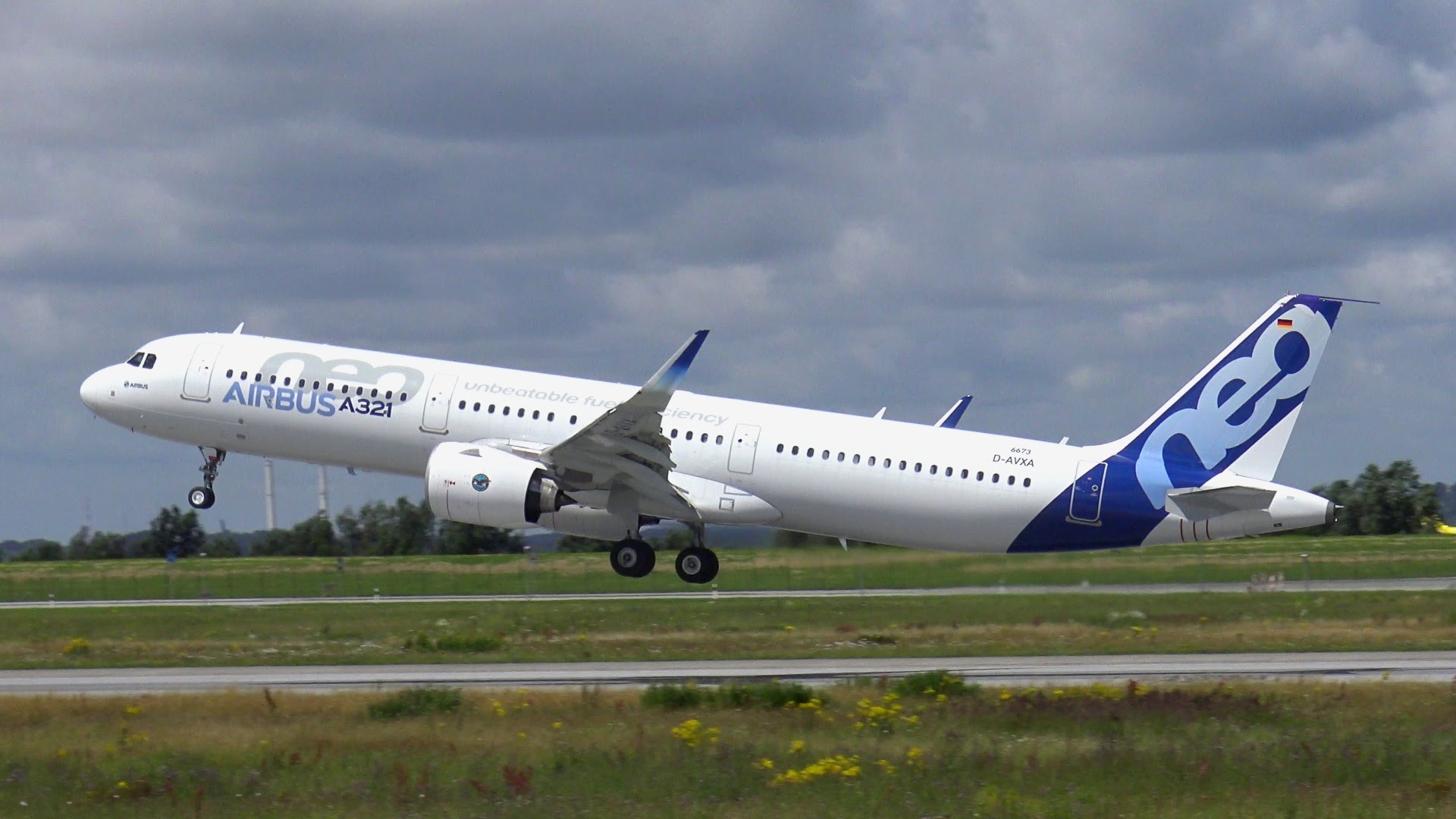
May 28, 2026, © Leeham News: This is the third article in a series that will use Airbus’ history and present technology work to deduce how Airbus will develop its next new airliner. The company’s current statement is that this new aircraft, a single-aisle model that will replace the A320/A321 series, will begin deliveries to airlines in the latter part of the next decade.
We looked into Airbus’ history in the last article to understand its DNA when it comes to aircraft development up to the last new aircraft, the A350-900. Now we look at the development that has been done since, all upgrades and further developments of existing platforms. Can it keep the Airbus’ engineering capability sharp for the task of the next new airplane?
Airbus’ Next New Airplane Part 1.
Subscription required
By Bjorn Fehrm and Scott Hamilton

Figure 1. Airbus will begin testing of CFM’s RISE Open Fan engine in 2029 on the company’s A380 test airplane. Credit: CFM.
May 25, 2026, © Leeham News: This is the first article in a series that will use Airbus’ history and present technology work to deduce how Airbus will develop its next new airliner. The company’s current statement is that this new single-aisle aircraft, which will replace the A320/A321 series, will begin deliveries to airlines by the latter part of the next decade.
What will its key benefits be, and how will Airbus develop and market such an aircraft? To understand this, we will conduct a historical sweep to examine what is in Airbus’ DNA regarding aircraft development, and what has changed in internal and external factors since the last new aircraft development, the A350-900, beginning in 2006.
The 787: When the System That Makes Change Incorporation Possible was Dismantled
Subscription Required
By the Leeham News Team
The last in a Series examining one of Boeing’s steps toward recovery.
May 18, 2026, © Leeham News: The Boeing 787 program, launched in 2004 with a promised first flight in 2007 and customer delivery in 2008, was not simply a new airplane. It was a complete reimagining of how a commercial jet could be designed, funded, and manufactured.

Credit: Leeham News.
Boeing’s senior leadership, facing intense financial pressure and seeking to reduce its own capital exposure in a multi-billion-dollar development program, chose to distribute both the manufacturing and financial risks across a global supply chain of risk-sharing partners.

The level of industrial outsourcing on the 787 program led to one of corporate America’s greatest industrial financial and execution disasters. Credit: Seattle Times.
Suppliers would not merely provide components. They would design, build, and deliver complete major assemblies—entire fuselage sections, the wing structure, the empennage. The suppliers would absorb the tooling and development costs themselves in exchange for long-term production revenue.
Related Stories
- Change incorporation: the high cost of getting it wrong
- Boeing’s Long Arc from Disciplined Rework to Distributed Chaos
- The 767: A Cockpit Crisis Creates the Template
- The 747-400: Derivative Programs Apply the Lessons
- The 777: Art form at its peak
The economic logic was genuinely compelling. Boeing watched Airbus fund the A380 with European government launch aid while Boeing shouldered its own development costs.
Executives thought that the risk-sharing model promised to drastically reduce Boeing’s capital outlay, spread the financial exposure across dozens of partners with their own balance sheets. Also, in theory, this model would harness the engineering capabilities of world-class suppliers who would bring design innovation along with manufacturing capacity. Suppliers like Mitsubishi, Kawasaki, Fuji, Alenia, and Spirit AeroSystems were not minor subcontractors. They were substantial aerospace manufacturers in their own right.
The 777: The Art Form at Its Peak
Subscription Required
By the Leeham News Team
Part 4 in a Series examining one of Boeing’s steps toward recovery.
May 14, 2026, © Leeham News: If there is a single moment in Boeing’s history when the pre-production change incorporation discipline reached its high point, it is the 777 program.

The Boeing 777-9 is the latest in the highly successful 777 family of airplanes. Credit: Leeham News.
Launched in October 1990, first flown on June 12, 1994, and certified on April 19, 1995, on schedule by Boeing standards, and with the unprecedented award of ETOPS-180 clearance simultaneous with entry into service, the 777 represented the integration of two decades of hard-won change incorporation experience with a transformative new tool: full digital design.

Credit: Leeham News.
This was legacy Boeing’s last hurrah, before the 1997 merger with McDonnell Douglas, and the shift from an engineering company to one focused on pleasing Wall Street.
Related Stories
- Change incorporation: the high cost of getting it wrong
- Boeing’s Long Arc from Disciplined Rework to Distributed Chaos
- The 767: A Cockpit Crisis Creates the Template
- The 747-400: Derivative Programs Apply the Lessons
The 777 program’s pre-production economics illustrated the principle at its most acute. United Airlines, the launch customer, placed an order for 34 firm aircraft and 34 options in October 1990. It was a transaction valued at approximately $11bn. United had a network plan that depended on those jets arriving on a specific schedule.
Boeing’s production system had to begin building customer aircraft well before the certification program could possibly conclude. This meant that by the time the type certificate was issued in April 1995, a substantial fleet of customer aircraft was already in various stages of completion.
Every one of these aircraft had been assembled to the engineering state at its specific build point in time. Each had a unique configuration history. And each required its own assessment before a change incorporation work package could be written for it.
The 747-400: Derivative Programs Apply the Lessons
Subscription Required
By the Leeham News Team
Part 3 in a Series examining one of Boeing’s steps toward recovery.
May 11, 2026, © Leeham News: The Boeing 747-400, which rolled out of Everett in January 1988 and earned its type certificate in January 1989.

This latest derivative of the Queen of the Skies was a substantial aircraft in its own right. New wings with six-foot winglets, a glass cockpit designed for two pilots in place of the classic three-crew analog flight deck, new engine options, tail fuel tanks, a new interior, and dramatically extended range made it, in certification terms, a new aircraft described as a derivative.

The first Boeing 747-400. Credit: Boeing.
The two-crew cockpit adoption on the 747-400 carried direct echoes of the 767 experience, but with the outcome predetermined. By 1988, the battle over crew complement for large jets had been decisively settled. The presidential task force findings, the success of the 767 and 757 in revenue service, and changing union contracts had all pushed the industry to the two-crew standard.
Related Stories
- Change incorporation: the high cost of getting it wrong
- Boeing’s Long Arc from Disciplined Rework to Distributed Chaos
- The 767: A Cockpit Crisis Creates the Template
The 747-400 introduced a new glass cockpit designed for a flight crew of two instead of three, reducing the number of dials, gauges, and knobs from 971 to 365 through the use of electronics. This reduction speaks volumes about how dramatically the systems integration philosophy had matured.
The 767: A cockpit crisis creates the template
The Economic Imperative—and the Battle Over the Flight Deck
Subscription Required
By the Leeham News Team
Part 2 in a Series examining one of Boeing’s steps toward recovery.
May 7, 2026, © Leeham News: To understand why the Boeing 767 program produced such a massive change incorporation effort, you first have to understand the political and engineering battle that exploded over its cockpit that was still being fought while the first aircraft were already rolling down the assembly line in Everett.

Large civil transport jets historically required a three-person flight crew: a captain, a first officer, and a flight engineer. The flight engineer occupied a panel-covered station just aft of and between the two pilots, responsible for managing the aircraft’s complex systems—fuel, hydraulics, pressurization, electrical loads, engine parameters, and dozens of other functions that were too numerous and too demanding for two pilots absorbed in actually flying to manage simultaneously.

The Boeing 767-200 originally was designed for a three person flight deck crew. After several aircraft were produced, the FAA approved operations with two pilots. Ansett Airlines of Australia was the only carrier to take delivery of a three-person configured 767. Credit Reddit WeirdWings.
By the late 1970s when Boeing was designing the 767, advances in avionics automation had changed the equation. Computer-driven systems monitoring, electronic alerting, and centralized digital displays meant that a widebody aircraft could theoretically be designed for a two-person crew without degrading safety.
Related Stories
- Change incorporation: the high cost of getting it wrong
- Boeing’s Long Arc from Disciplined Rework to Distributed Chaos
Boeing and most airline customers badly wanted the two-crew configuration. The financial savings from eliminating a flight engineer on every flight were substantial. Over thousands of annual flight hours per aircraft, the labor cost differential between a two-crew and three-crew operation compounded into millions of dollars per jet per year across a fleet.
Furthermore, a common two-crew type rating shared with the narrowbody 757, being designed concurrently, would give airlines enormous scheduling flexibility and reduce transition training costs. Every major airline customer had powerful economic incentives to push for two-crew operations.
The state of alternative propulsion aircraft? Part 10.
Subscription required
By Bjorn Fehrm
May 6, 2026, © Leeham News: In our series on the state of alternative propulsion projects, we are looking at different hydrogen-fueled propulsion systems.
Hydrogen can either be processed chemically in a fuel cell to produce electrical power, which is then coupled to an electrical motor system, like for hybrids or battery electric aircraft. The advantage is that the system gets rid of the inefficient batteries that kill these systems.
The other alternative is to burn the hydrogen in the combustor of a gas turbine. The advantage is we keep the high power to mass ratio of a gas turbine with a heavier and more complicated fuel system, but a lighter fuel than Jet Fuel/SAF.
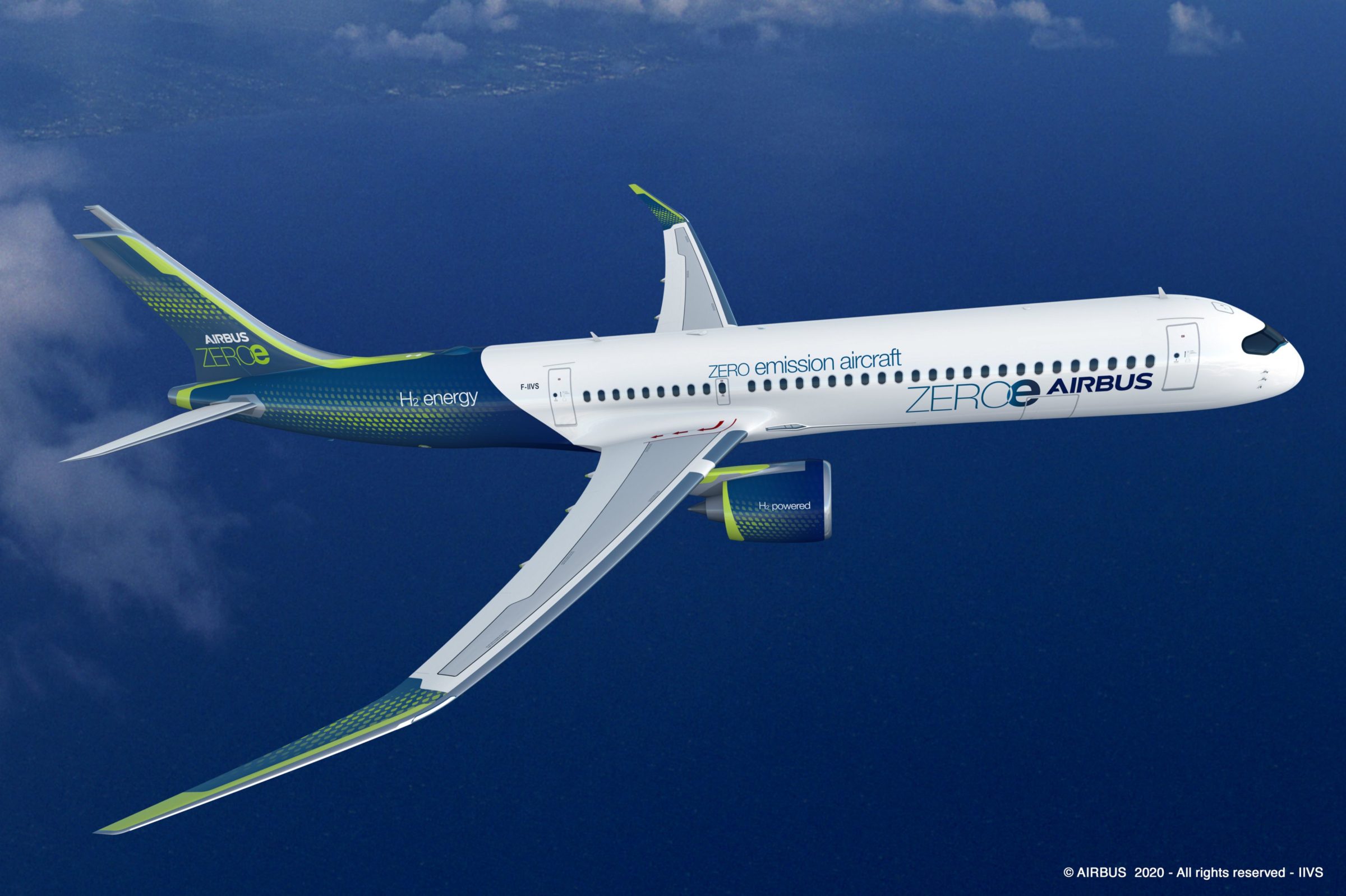
Figure 1. The hydrogen-burn airliner in Airbus’ ZEROe concepts. Source: Airbus.
Now we dive deeper into the gas turbine hydrogen burn variant.
Boeing’s Long Arc from Disciplined Rework to Distributed Chaos
Subscription Required
By the Leeham News Team
Part 1 of a five part series about Boeing’s path to recovery.
May 4, 2026, © Leeham News: From a 30-airplane cockpit rework crisis on the 767 to a supplier-driven configuration mystery on the 787, the history of Boeing’s pre-production change incorporation process is a master class in what happens when an industry’s best practices are forgotten in the name of financial engineering.
Getting it right the first time and avoiding time-consuming, costly rework are crucial for Boeing’s future airplane programs—and its long-term financial recovery.
In a previous article, LNA detailed “the high cost of getting it wrong.” We continue our in-depth exam of some of the fundamentals of Boeing’s path to recovery.
Related Story

The change incorporation events for the Boeing 767, 747-400, 777, and 787 are examined in the five-part Leeham News special report. Credit: Leeham News.
What Change Incorporation Actually Is—And Why It Is So Hard
When Boeing builds an entirely new type of airliner, the factory does not wait for regulators to complete their final review before rolling jets off the assembly line. Assembly of pre-production aircraft begins months or years before the FAA issues a type certificate.
There is a powerful economic logic driving this decision. A new commercial jet program represents an investment of billions of dollars. Every month that passes between the start of certification flight testing and the first revenue-generating delivery is a month of continued capital consumption with no return.
Airlines that signed purchase agreements are planning route networks, crew training schedules, and fleet retirements around contracted delivery dates. The manufacturer’s entire financial model for a new program depends on compressing the interval between first flight and first delivery to the greatest extent possible.
As aerospace companies pursue AI, FAA lags
Subscription Required
By Scott Hamilton

Pat Shanahan during his Boeing career. Credit: Seattle Times.
April 27, 2026, © Leeham News: Antiquated air traffic control systems and staffing shortages of the Federal Aviation Administration (FAA) have been well-known for decades.
Budget and staffing cuts at the FAA by the Trump Administration through its DOGE policy exacerbated these issues. Also affected, but less well known, are staff cuts in the technical and maintenance areas, which also hurt FAA operations.
Even less well known is that certification by the FAA has been dramatically slowed. There are a number of reasons, and certification affects a variety of aircraft programs and companies. Boeing gets the most headlines for the continued delays in certifying the 737-7, 737-10, and 777-9. But this doesn’t stop with Boeing.
Freighter conversion programs by IAI Bedek, a company with a long-established history of converting Boeing products, ran about two years late in certifying its first 777-300ER passenger-to-freighter conversion. Mammoth Freighters, a start-up company created in competition with IAI for -300ER P2F conversions, received its STC in April, behind its 2025 target. Issues contributing to certification delays include licensing intellectual property, engineering delays within the company, and related challenges.
But an underlying issue affecting everyone, aside from staffing shortages and expertise, is that the FAA is stuck in the spreadsheet-and-hard-copy era. As companies advance to the use of Artificial Intelligence (AI), they are moving faster than the FAA.
As eVTOL and unmanned aircraft firms seek certification, the FAA must develop new regulations. When Boeing, Airbus, GE, and Pratt & Whitney design new airplanes and engines, they’re counting on AI to speed development and certification. But the FAA currently relies on spreadsheets to track details and progress. Furthermore, conflicting regulations create unexpected problems. Ed Bastian, the CEO of Delta Air Lines, called on the FAA to use AI to help solve ATC problems.
Related articles
- Boeing awash in FAA certification requirements
- FAA proposes ways to speed up certification
- At long last, certification for 777X appears near
- Boeing clearly behind in 777X certification
- Faster aircraft development
- Boeing’s 737 “hangover” is over
- Staffing shortages affect ATC and Boeing
- FAA begins to ease restrictions on Boeing
Boeing’s VP of Product Development, Brian Yutko, believes the industry is on the precipice of an AI revolution. Pat Shanahan believes AI will be ready in 18 to 24 months to play a major role in developing the next commercial airliner. Shanahan was a 30-year Boeing veteran across commercial and defense programs, a former deputy secretary of the US Department of Defense, and, most recently, the CEO of Spirit AeroSystems, a major supplier to Airbus, Boeing, and several defense companies.
AI: “The precipice of an absolute technology revolution”
Subscription Required
By Scott Hamilton
Part 4

In 2017, Boeing published “Innovation Quarterly”, covering a wide range of company efforts in new technology–including Artificial Intelligence. Credit: Boeing.
April 23, 2026, © Leeham News: Expanding the use of Artificial Intelligence (AI) will be an important part of developing Boeing’s next new airplane, whatever it is.
During an appearance last month at the Pacific Northwest AIAA (American Institute of Aeronautics and Astronautics), Boeing’s VP of Product Development outlined how AIAA may be used in the future. Brian Yutko declined to specifically tie AI to any specific new airplane program. However, he addressed how this and other new technology applies to new aircraft development.
In addition, LNA has been independently learning from its sources how Boeing will use AI for its future airplane programs.
Yet for all the growing attention about AI in today’s world, it’s hardly new. As far back as 2017, Boeing began telling the world about its interests in AI. In June that year, Boeing announced that its Boeing HorizonX venture capital arm acquired a Texas firm, SparkCognition, a machine-learning company.
“SparkCognition has established itself as a machine learning technology leader, developing a cognitive, data-driven analytics platform for the safety, security and reliability of data technology for customers in energy, oil and gas, manufacturing, finance, aerospace, defense, telecommunications and security,” Boeing said in its press release.
A search of Boeing’s archives reveals announcement after announcement about AI investment, research and activities.
On perhaps a more mundane level, the maintenance monitoring systems on Boeing, Airbus and other airplanes have long been a money-saving part of operations. As airliners are enroute, these systems monitor the “health” of the aircraft. If something “wrong” is detected, a message can be sent to the airline’s maintenance department to be ready with a solution as soon as the aircraft arrives at its gate.
Related Articles
- Boeing’s 30 year march to a new airplane
- What will Boeing’s next new airplane be?
- New technology for Boeing’s next airplane
- WISK technology for Boeing’s next airplane