
Leeham News and Analysis
There's more to real news than a news release.


Bjorn’s Corner: Aircraft Structures Part 3. New Alloys with Issues

By Bjorn Fehrm
May 29, 2026, ©. Leeham News: We do a series on aircraft structures and how these have shaped how our airliners can transport us around the world today.
We started the history of aircraft structures last week by observing that the development of structures is very much tied to the development of materials, with the crossover from wood to metal enabled by the discovery of copper-alloyed aluminum, which was originally patented as Duralumin.
We will now look at the stressed skin construction this enabled and the development of a second class of alloyed aluminum, the Zinc alloyed class, today classified as part of the 7000 series.

Figure 1. DC-3, the most influential stressed skin aircraft between the wars. Source: Silodrome.com
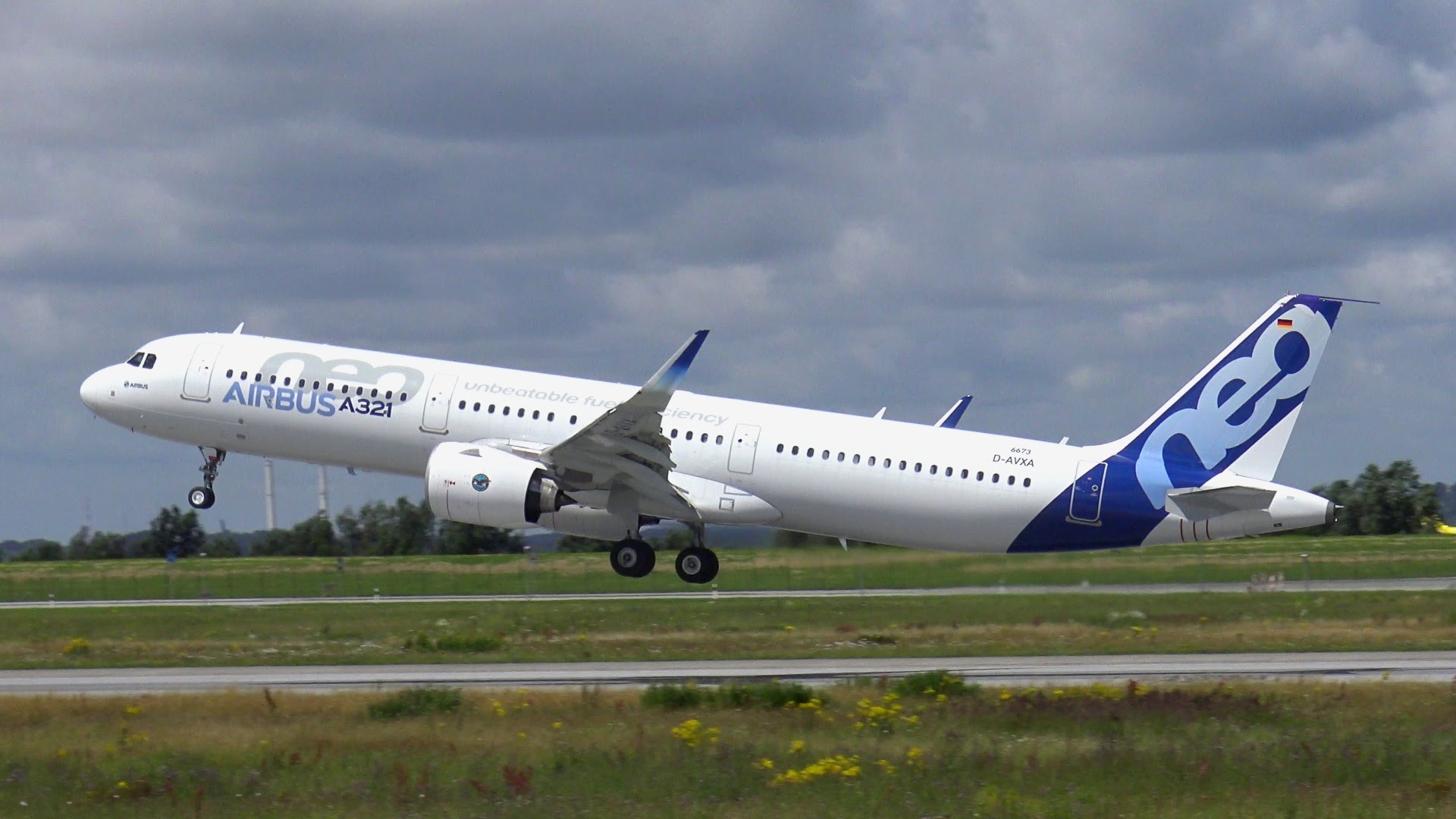
Airbus Next New Airplane Part 2. The neo Success.
Subscription required
By Bjorn Fehrm and Scott Hamilton
May 28, 2026, © Leeham News: This is the third article in a series that will use Airbus’ history and present technology work to deduce how Airbus will develop its next new airliner. The company’s current statement is that this new aircraft, a single-aisle model that will replace the A320/A321 series, will begin deliveries to airlines in the latter part of the next decade.
We looked into Airbus’ history in the last article to understand its DNA when it comes to aircraft development up to the last new aircraft, the A350-900. Now we look at the development that has been done since, all upgrades and further developments of existing platforms. Can it keep the Airbus’ engineering capability sharp for the task of the next new airplane?
Bjorn’s Corner: Aircraft Structures Part 2. The History is governed by Materials.
By Bjorn Fehrm
May 22, 2026, ©. Leeham News: We do a series on aircraft structures and how they have shaped the way our airliners transport us around the world today.
We start with the history of aircraft structures, as this is a good way to understand where we are today. Mankind has dreamt of flying like the birds. It was also the birds that inspired the first wing kits that were assembled by men like Otto Lilienthal. He put on bird-like wings and flew down a slope in Berlin in 1895, Figure 1.
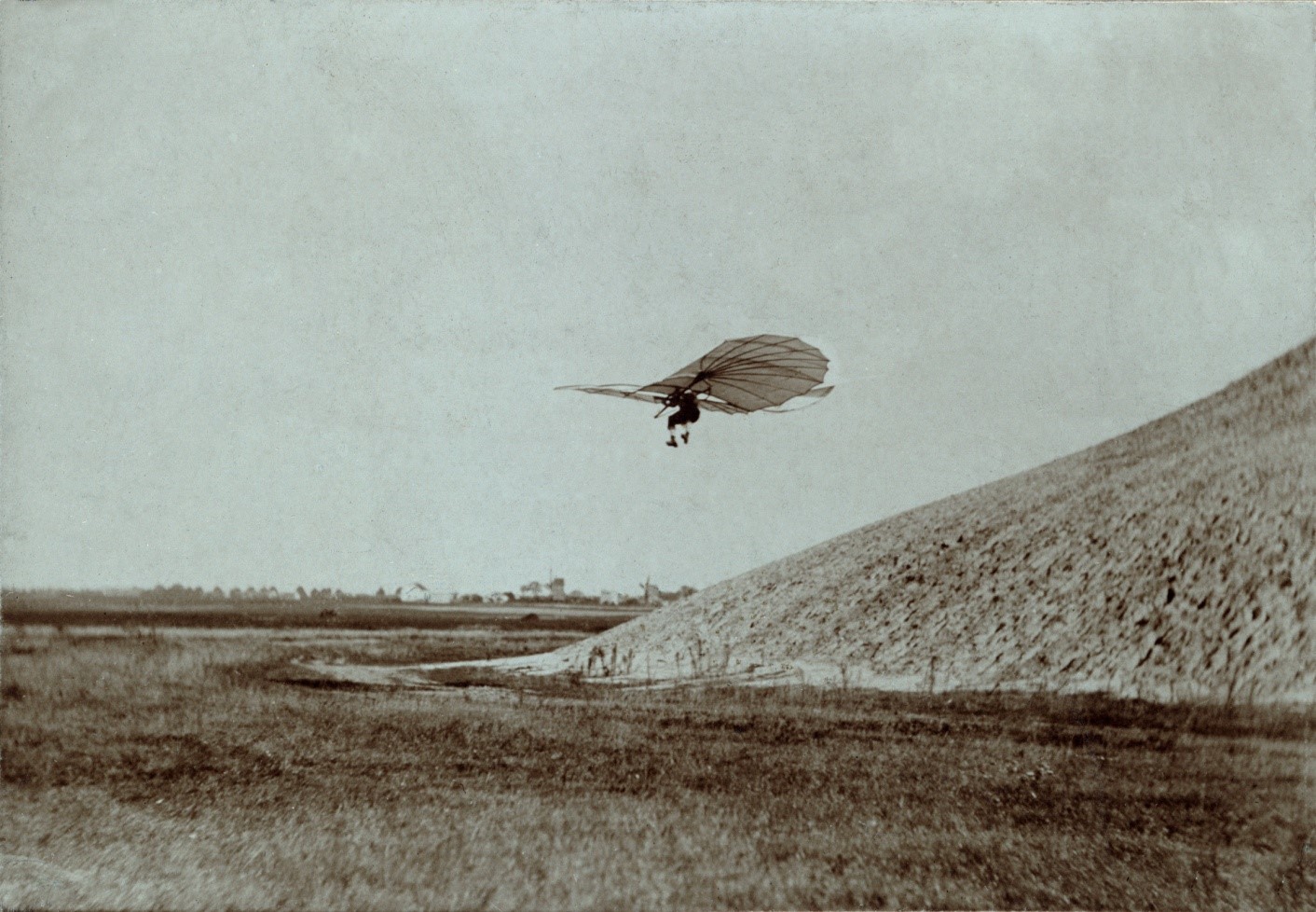
Figure 1. Ott Lilienthal with his glider wings in Berlin, 1895. Source: Wikipedia.
Lilienthal and other pioneers studied how the birds flew and took ideas on wings and tail from these. They covered a wooden structure, often made of bamboo, with cloth to give the wings an aerodynamic shape.
Bjorn’s Corner: Airliner Structures. Part 1
By Bjorn Fehrm
May 15, 2026, ©. Leeham News: We have finished a series on Blended WingBody (BWB) airliners, where one of the tougher challenges will be the design of the airframe structures.
In aircraft design, the aerodynamic shape of the aircraft gets a lot of attention for obvious reasons; it’s what we see, and if it’s well-made, it’s aesthetically beautiful.
For successful aircraft designs, a well-thought-out and designed structure is equally important. Aircraft designers and experts recognize a well-thought-out, well-designed structure when they see it, and it is an equally beautiful experience. In the series, we will see that the most iconic aircraft had a brilliant structural design.

Figure 1. The typical structural parts of an airliner fuselage (A320 fuselage structure). Source: Airbus.
We start the series on structures with what these must cover in terms of requirements. Then we go through how they have evolved over time, and finally we describe the changes that must occur over the next few years to meet the requirements of the next generation of airliners.
Bjorn’s Corner: Blended Wing Body Airliners. Part 9
By Bjorn Fehrm
May 8, 2026, ©. Leeham News: We have made a series of articles on the Blended Wing Body (BWB) as a potentially more efficient design for passenger-carrying airliners than the classical Tube-And-Wing (TAW) configuration.
In last week’s article, we looked at the passenger experience on the JetZero Z4 and how the emergency escape facilities would be organized. There have been a lot of discussions on how a passenger will feel flying in a main cabin with only wide screens simulating side windows, with natural light coming through skylights in the roof. It’s difficult to say what the feeling will be. In a widebody aircraft, we sit at ease, far from the outside windows.
The emergency exit concept is straightforward, except for water landings, where buoyancy may be insufficient to keep the water line below the emergency exit doors. In that case, there have to be roof exits where the skyports are, made into emergency exits, along with some means to reach them.

Figure 1. The JetZero Z4 BWB. Source: JetZero.
Now it’s time to summarize what else we learned in the series.
The state of alternative propulsion aircraft? Part 10.
Subscription required
By Bjorn Fehrm
May 6, 2026, © Leeham News: In our series on the state of alternative propulsion projects, we are looking at different hydrogen-fueled propulsion systems.
Hydrogen can either be processed chemically in a fuel cell to produce electrical power, which is then coupled to an electrical motor system, like for hybrids or battery electric aircraft. The advantage is that the system gets rid of the inefficient batteries that kill these systems.
The other alternative is to burn the hydrogen in the combustor of a gas turbine. The advantage is we keep the high power to mass ratio of a gas turbine with a heavier and more complicated fuel system, but a lighter fuel than Jet Fuel/SAF.
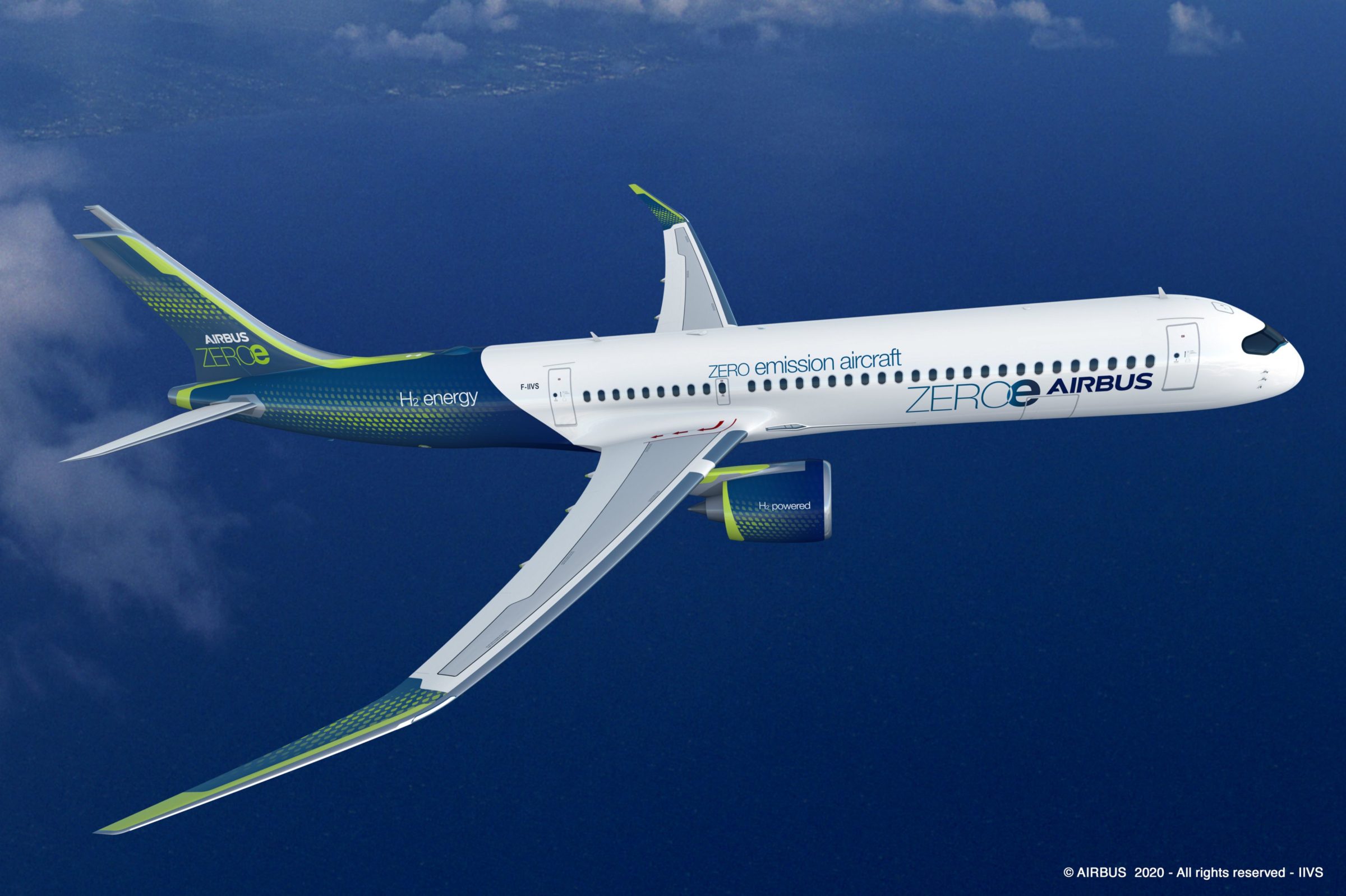
Figure 1. The hydrogen-burn airliner in Airbus’ ZEROe concepts. Source: Airbus.
Now we dive deeper into the gas turbine hydrogen burn variant.
Bjorn’s Corner: Blended Wing Body Airliners. Part 8
By Bjorn Fehrm
May 1, 2026, ©. Leeham News: We are making a series of articles on the Blended Wing Body (BWB) as a potentially more efficient design for passenger-carrying airliners than the classical Tube-And-Wing (TAW) configuration.
In the seventh article last week, we discussed the structural difference between a BWB and a Tube-And-Wing aircraft. The classical aircraft has divided the cabin pressure problem, causing cyclic pressure stress on the cabin enclosure, by enclosing the cabin in an optimal closed-tube configuration, and the wings’ aerodynamic stresses from gusts, hard landings, and the possible engine-out case are managed by a one-piece wingbox from tip to tip of the wing. These loads differ in character and therefore use different structural concepts in tube and wing aircraft.
The BWB mixes these loads, where the cabin shape, being a wide and long box-like compartment, complicates the structural concepts, where fatigue-sensitive bending loads from the cabin pressure are hard to avoid. It’s not made easier by the wing loads being absorbed by the same structure.
Figure 1. The JetZero Z4 BWB. Source: JetZero.
Now we look at some BWB passenger-compartment challenges compared with TAW solutions.
Bjorn’s Corner: Blended Wing Body Airliners. Part 7
By Bjorn Fehrm
April 24, 2026, ©. Leeham News: We are making a series of articles on the Blended Wing Body (BWB) as a potentially more efficient design for passenger-carrying airliners than the classical Tube-And-Wing (TAW) configuration.
In the sixth article last week, we discussed how the drag characteristics of the BWB and a high optimal cruise altitude have consequences for the choice of engines. The thrust lapse due to altitude is higher than for Tube-And-Wing aircraft that fly about 10,000ft lower. The JetZero Z4, therefore, needs engines adapted for high climbs and cruise conditions.
This requires engines with higher specific thrust, which means lower Bypass Ratios (BPRs). This runs counter to the development trend of modern engines, which reduce specific thrust in each generation to improve propulsive efficiency and thus lower fuel burn.

Figure 1. The JetZero Z4 BWB. Source: JetZero.
Now we look at the challenges in the structure domain for a BWB. At first glance, it should be a lighter structure than a Tube-And-Wing aircraft, as it does away with the fuselage and empennage. In reality, it’s more complicated than that.
Bjorn’s Corner: Blended Wing Body Airliners. Part 6
By Bjorn Fehrm
April 17, 2026, ©. Leeham News: We have started a series of articles on the Blended Wing Body (BWB) as a potentially more efficient design for passenger-carrying airliners than the classical Tube-And-Wing (TAW) configuration.
In the fifth article last week, we discussed how the drag characteristics of the BWB are different from a classical Tube-And-Wing airliner. The dominance of air-friction drag over induced drag results in a 10,000ft higher optimal cruise altitude compared with an equal-capacity TAW.
We compared JetZero’s Z4 project to a 250-seat variant of Boeing’s NMA that we have analyzed several times with our Aircraft Performance and Cost Model, APCM. Both aircraft use modern composite structures, aerodynamics, and systems, resulting in similar overall weights and drag.

Figure 1. The JetZero Z4 BWB. Source: JetZero.
The difference is how the drag is partitioned between the wetted area caused drag (air friction drag) and drag due to weight (induced drag). The difference between drag and optimal cruise altitudes has consequences for engine choice. Here is how.
Bjorn’s Corner: Blended Wing Body Airliners. Part 5
By Bjorn Fehrm
April 10, 2026, ©. Leeham News: We have started a series of articles on the Blended Wing Body (BWB) as a potentially more efficient design for passenger-carrying airliners than the classical Tube-And-Wing (TAW) configuration.
In last week’s article, we discussed how the wingspan is an important factor in an airliner’s takeoff performance. The induced drag is about 85-90% of the drag at the critical V2 point after rotation, where regulations require that a twin-engined airliner be able to fly on one engine with a climb rate of 2.4%.
We now go through the entire mission for a BWB airliner and compare its drag characteristics with those of a classical Tube-And-Wing (TAW) design.
Figure 1. The JetZero Z4 BWB. Source: JetZero.