
Leeham News and Analysis
There's more to real news than a news release.


Part 1: Workforce Shortage Stunting Industry Growth, Costing Billions
Summary:
- This two-part series outlines the threat posed by workforce shortages to the future growth of aviation and aerospace, since industry-wide costs of workforce shortages are unquantified. Estimates suggest the industry is leaving tens of billions on the table as a result
- Technology alone cannot solve the problem as the workforce changes
- Current industry efforts to address the workforce are fragmented and, to elevate aviation/aerospace pathways and careers, must be coordinated with organizations delivering educational and career programs
- The solution is a collaborative, professionally managed Early-Learning-to-Career Pipeline leveraging existing programs and alliances to guide youth to aviation/aerospace careers
- Industry must pivot from relying on government to investing in organizing the army and educational and career assets we already have.
- Success requires industry-wide proactive collaboration, cultural change, and investment.
By Kathryn Creedy
May 5, 2026, © Leeham News: Not one of the numerous studies from every aviation/aerospace policy organization has quantified the costs of not addressing our workforce shortages at an industry-wide level, although concerns are rising at the academic level. And there is little effort in developing a unified career pipeline guiding the kids we are already inspiring into our careers, as other industries have long been doing.
Only a few estimates exist on the cost of workforce shortages:
- Aeronautical Repair Station Association (ARSA): Perhaps ~$14bn for the maintenance industry.
- Boston Consulting Group (BCG): Unavailable aircraft and MRO inefficiencies cost the industry $27bn annually.
- McKinsey & Co: Cost of Attrition for one medium-sized company is ~$300m–$330m
- International Air Transport Assn. (IATA)The additional cost borne by the airline industry from the supply chain was over $11bn in fuel and maintenance.
Aviation and aerospace policy groups in Washington, in their rush to convince policy leaders about the importance of their multi-billion-dollar impact on the economy, might be missing the forest for the trees in not quantifying the costs.

Raisbeck Aviation High School in Seattle is privately funded. Students study to become aerospace engineers. Credit: Raisbeck Aviation High School.
It is clear that the aviation, aerospace, and defense industries contribute billions to the economy, but two important facts are missing.
The total talent forecast for all segments of the industry and the cost of failing to meet workforce needs.
All studies cite rising compensation, higher maintenance, repair and overhaul (MRO) and manufacturing costs, and the costs associated with delays in returning aircraft from maintenance and in delivering new aircraft off the production line. But none quantifies how much those rising costs are.
Nor are they calculating the cost to safety, despite rising concerns over the loss of seasoned aviators and aviation maintenance technicians, and the resulting “juniority” on the flight deck and in the maintenance bay. Exacerbating our shortages is the training pipeline with a shortage of instructors, professors, and teachers.
Pontifications: Looking ahead to a major Defense procurement: Boeing vs Lockheed-Airbus

By Scott Hamilton
May 23, 2023, © Leeham News: Decisions by the US Air Force in Washington (DC) on whether to require competition for its next round of aerial refueling tanker aircraft are still months away.
But so far, the USAF technical group at the Wright-Patterson Air Force Base in Dayton (OH) is proceeding as if there will be a competitive battle. At stake is an order for more than 160 tankers.
Boeing thinks this will be a sole-source, follow-on order for its KC-46A, based on the commercial 767-200ER. Lockheed Martin Co (LMCO), partnering with Airbus, wants to see a version of the Multi Role Tanker Transport (MRTT), based on the commercial A330-200.
So far, the secretary of the Air Force publicly said he is leaning toward a sole-source follow-on order.
I visited LMCO last month to talk about the tanker competition. We also talked about the C-130J and its new commercial model, as well as other defense programs.
Pontifications: Advice for Boeing in the coming KC-Y campaign
Part 6: The KC-X competition from Boeing’s perspective
By Scott Hamilton
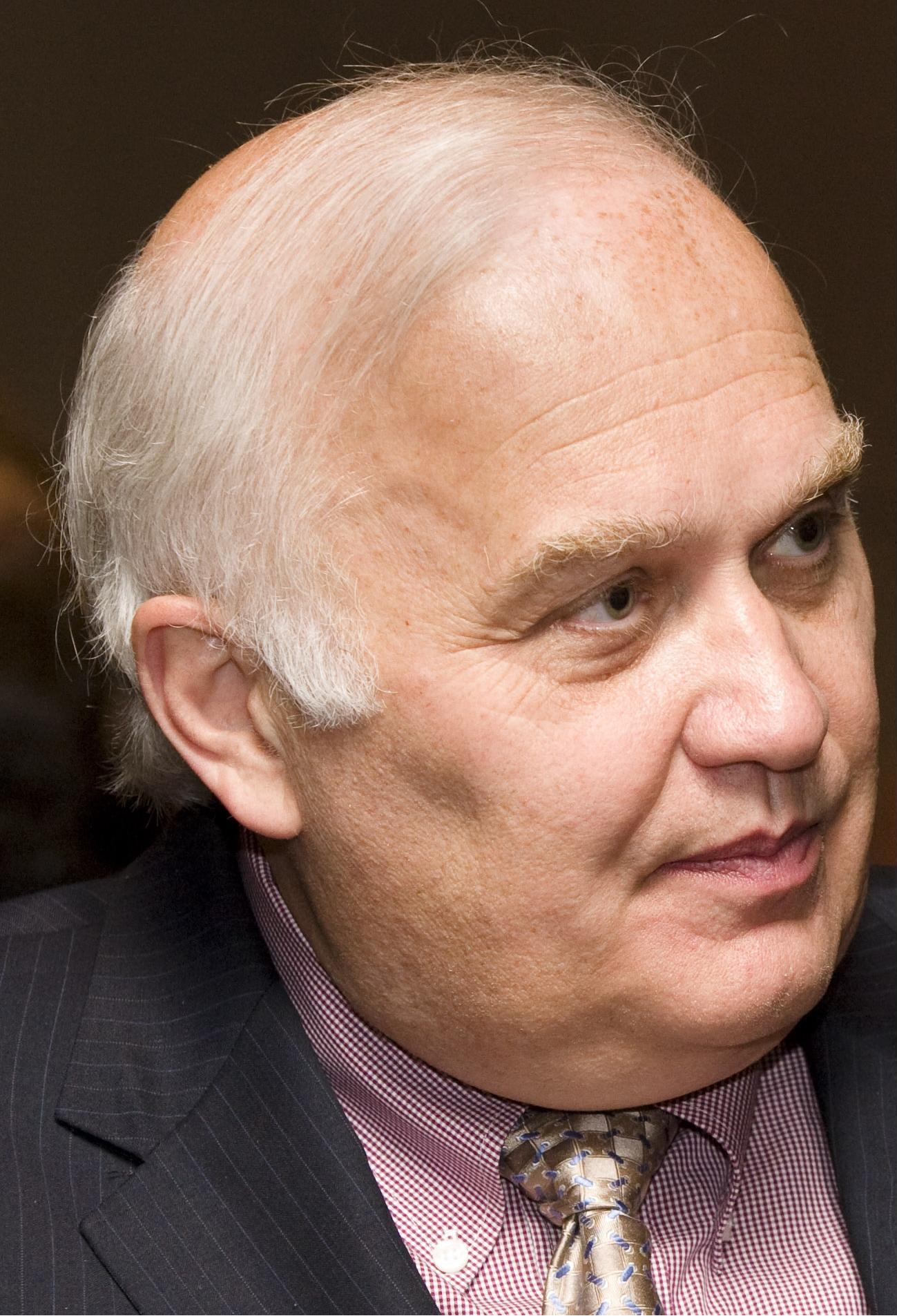
Feb 21, 2022, © Leeham News: Jim Albaugh, the former president and CEO of Boeing Commercial Airplanes and of Boeing’s defense unit, retired from the company in 2012. He oversaw the first competitive bid at the defense unit for the US Air Force KC-X refueling tanker. That was lost to Northrop Grumman-EADS (Airbus) in 2009.
As CEO of BCA, he oversaw commercial efforts to get Boeing’s cost down on the 767-200ER, which formed the basis for what became the KC-46A tanker. Defense won this round against a solo EADS bid. Boeing’s winning price was about 10% below the EADS bid for its A330-based MRTT.
Years removed from Boeing but nevertheless an interested observer with experience on the losing and winning bids, Albaugh has some observations and advice as Boeing prepared to compete against Lockheed Martin-Airbus for the KC-Y campaign that already has unofficially begun.
Pontifications: “The mother of the last pilot on the 707 tanker hasn’t been born yet”
 Part 3 of the Boeing focus for the USAF Aerial Refueling Tanker
Jan. 31, 2022, © Leeham News: Following the 9/11 terrorist attacks in the United States, Boeing offered the US Air Force a lease deal for 100 aerial refueling tankers based on the 767-200.
By Scott Hamilton
The concept of leasing tankers had been floated before. Boeing at one point proposed creating a 747-based tanker and leasing it to the Air Force. The idea went nowhere, but this one gained traction.
The leasing concept formed just before Jim Albaugh arrived at IDS, but he was president as it progressed and through the subsequent competition, called KC-X, against Northrop Grumman-EADS (Airbus) after the lease deal was canceled.
“You go back in history, and it started out with the need for the Air force to replace the 707s which were their tanker fleet for a long time, and they were getting old,” recalls Albaugh, the CEO of Boeing’s Integrated Defense Systems unit at the time. IDS is now called Boeing Defense, Space and Security (BDS).
Lockheed Martin sees LMXT as complementary to KC-46A, not competitive
Subscription Required
Now open to all readers
By Scott Hamilton
Jan. 30, 2022, © Leeham News: Lockheed Martin’s LMXT US Air Force refueling tanker will be a complementary offer to the service in the forthcoming KC-Y competition.

Larry Gallogly
In an exclusive interview with LNA earlier this month, Lockheed Martin (LMCO)’s LMXT Campaign Director, Larry Gallogly, said the Air Force wants an airplane that is bigger, has more range, and more fuel offload than the incumbent Boeing KC-46A. This fits the LMXT, based on the Airbus A330-200 Multi-Role Tanker Transport (MRTT) now in production.
Airbus partnered with LMCO in 2018 to prepare for the KC-Y competition. Airbus has 61 orders for the MRTT from around the world. Boeing is building 179 tankers for the Air Force from the original KC-X competition. It has a handful of orders from other countries.
The KC-Y contact will be for up to 160 tankers. The competition will pit Boeing and Airbus against each other for the third time. Airbus first teamed with Northrop Grumman in the first round of the KC-X campaign. Northrop won the contract, but the award was protested successfully by Boeing. Northrop dropped out of the recompete, with Airbus going alone. This time, Lockheed Martin will be the lead, and Airbus the subcontractor.
The two fights were bitterly waged in the public and political domains. LMCO hopes to avoid a repeat.
No plans to relitigate
“We have, from the start of this, with both ourselves and Airbus, have had no intention of re-litigating the [KC-X] competition,” Gallogly said. “Our goal has always been to provide what we consider to be a complementary capability. There are going to be 179 KC-46s out there, but there are significant capability gaps that the US Air Force has that this LMXT can fill. We are not trying to provide the same capability in a different wrapper. Our goal is to provide a very different capability and, again, fill those gaps.”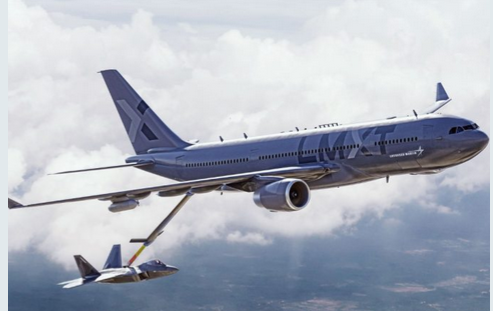
Gallogly said that after talking to the Air Force and Pentagon repeatedly, from the Air Mobility Command to transportation command to the individual theater commanders, to the people in the Pentagon, “what we heard consistently was that the gap exists for fuel offload at strategic ranges. You know as everybody who focuses on the Pacific Theater, you’re faced with the tyranny of distance there, and we needed to provide as much fuel offload as we possibly could.”
Pontifications: A retrospective of the KC-X refueling tanker competition from Boeing’s perspective
Part 2 of the Boeing focus for the USAF Aerial Refueling Tanker
Jan. 24, 2022, © Leeham News: Jim Albaugh was president of Boeing Integrated Defense System (IDS), now known as Boeing Defense, Space and Security (BDS) during the competition for the US Air Force’s KC-X program.
By Scott Hamilton
After 9/11 (2001), Boeing was reeling as US airlines canceled or deferred orders in the aftermath of the terror attacks in New York City and Washington (DC). Terrorists hijacked four airplanes (all Boeing, as it turned out) operated by American and United airlines. Then, US carriers dominated the world market as customers for Boeing and Airbus. Boeing was disproportionately affected, as it was the USA’s two biggest airlines that were victims of the terror attacks.
Pontifications: Boeing’s alphabet soup of airplanes and more
- It’s time for catching up on Odds and Ends.
By Scott Hamilton
March 2, 2020, © Leeham News: NMA. NSA (version 1). NSA (version 2). NLT. FSA. MOM.

By Scott Hamilton
These are Boeing’s acronyms for its next airplane. Whatever it will be.
NMA stands for New Midmarket Airplane.
NSA version 1 stood for New Single Aisle Airplane. It was replaced by version 2, New Small Airplane. This was replaced by FSA, Future Small Airplane. Some called this the Future Single Aisle airplane.
Then there is NLT, New Light Twin, from 2011. Which really begot the NMA, which was initially the MOM, or Middle of the Market Airplane. We called it MOMA at times.
It’s all very confusing. The Next Boeing Airplane is such a moving target. Maybe it should be called the NBA, although some association involving basketball might object. (The Next Airbus Airplane logically would become the NAA.)
Then there is the next new airplane from Embraer, after its joint venture with Boeing is finally approved (as I believe it will be).
Embraer CEO John Slattery want to do a turboprop. So does this become the E3TP?
The JV agreement calls for Embraer (to be named Boeing Brasil-Commercial) to do the next jet in the 100-150 seat category. Does this become the E3150, E3JET, BBCX or something else?
Bjorn’s Corner: Yaw stability, Part 2

By Bjorn Fehrm
March 01, 2019, ©. Leeham News: We now continue our discussion of the yaw stability of an airliner.
Last week we defined the basic conditions of yaw stability. The aerodynamic side force from an angled airflow stemming from an aircraft yaw angle or sideslip must be higher behind the center of gravity than ahead of the center of gravity.
This is why aircraft have a large vertical wing at the rear of the aircraft called the vertical tailplane. Figure 1.
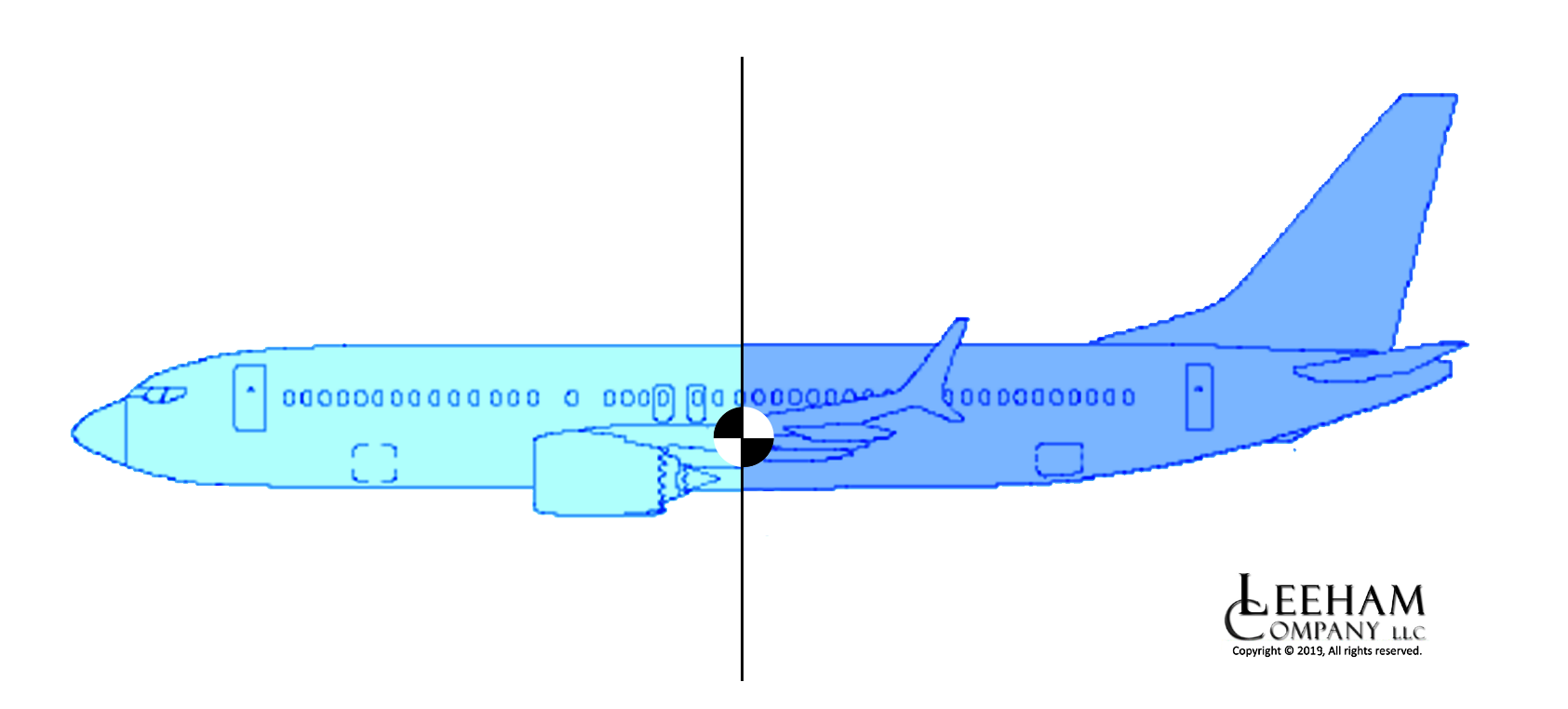
Figure 1. The surfaces affecting yaw stability on an aircraft. Source: Leeham Co.
Tanker wars may be back
Subscription Required
Introduction
Dec. 10, 2018, © Leeham News: The tanker wars may be back.
Airbus has teamed with Lockheed Martin to offer the Airbus A330-200MRTT to the Pentagon in a for-hire business model. The agreement also provides the prospect of “conceptualizing the tanker of the future.” (The press release is here.)
From 2001-2011, the US Air Force, Pentagon and even Congress were embroiled in controversy over recapitalization of the USAF aerial refueling tanker fleet.
The KC-135s, based on the Boeing 707, were aging, expensive to maintain and outdated.
After 9/11, Boeing proposed leasing 100 tankers based on the 767-200ER to the USAF. A scandal surrounding the USAF approval of this deal sent the air force’s procurement office and Boeing’s CFO to jail and resulted in the resignation of CEO Phil Condit. The lease deal was canceled.
Summary
- Three rounds of tanker procurement were filled with improprieties, bitter charges and counter charges.
- Boeing currently has a contract for 52 KC-46A tankers out of an initial procurement of 179.
- The air force sees a need for 100 more tankers on an accelerated timeline.
- Fee-based refueling is not unknown to the Pentagon.
Suppliers conference in Mobile focuses on US aerospace sector in Southeast

Click on image for an enlarged, crisp view.
Oct. 31, 2017: A new event, the Southeast Aerospace and Defence Conference (SADC) scheduled for June 25-27 in Mobile (AL), will examine the commercial, defense, space and corporate aerospace sectors in the US Southeast.
The conference is organized by Airfinance Journal and Leeham Co., the first joint venture between the two companies.
The US Southeast is a growing aerospace center. Defense and space clusters have decades-long histories in the Southeast. Corporate and commercial clusters are more recent developments, albeit in some cases now well within a second decade.
Airbus’ A320 family Final Assembly Line in Mobile opened in September 2015. The FAL is producing 3.5 A320s per month and will reach its initial target of 4/mo by year end, slightly ahead of schedule. There is land capacity to expand to 8/mo.
Earlier this month, Airbus and Bombardier announced that their new venture will establish an FAL in Mobile.