
Leeham News and Analysis
There's more to real news than a news release.


Bjorn’s Corner: Faster aircraft development. Part 14. Detailed Design.
October 31, 2025, ©. Leeham News: We do a series about ideas on how the long development times for large airliners can be shortened. New projects talk about cutting development time and reaching certification and production faster than previous projects.
The series will discuss the typical development cycles for an FAA Part 25 aircraft, called a transport category aircraft, and what different ideas there are to reduce the development times. We will use the Gantt plan in Figure 1 as a base for our discussions.
We have exited the Preliminary Design phase through the Preliminary Design Reviews, PDRs, and now enter the Detailed Design phase.

Figure 1. A generic new Part 25 airliner development plan. Source: Leeham Co. Click to see better.
Airbus’ A321neo, A321LR or A321XLR? Part 2.
Subscription required
By Bjorn Fehrm
October 30, 2025, © Leeham News: We went through the creation of Airbus’s A321 in the first article, and why its initial sales were slow, and why the sales only picked up after the launch of the A320/A321neo models, and how it came to dominate sales and deliveries in the A320 family after COVID.
For an airline, it’s now a matter of what mix of the different A321neo variants to buy. Is there a large penalty to “misuse” an A321LR or XLR on shorter routes, or can a fleet of the more expensive and heavier models be used on shorter routes to cover gaps and increase their daily utilization without a cost penalty?
To get the answer, we look into the different A321neo variants and compare their capacities and operational costs in this article using the Leeham Aircraft Performance and Cost Model, APCM.
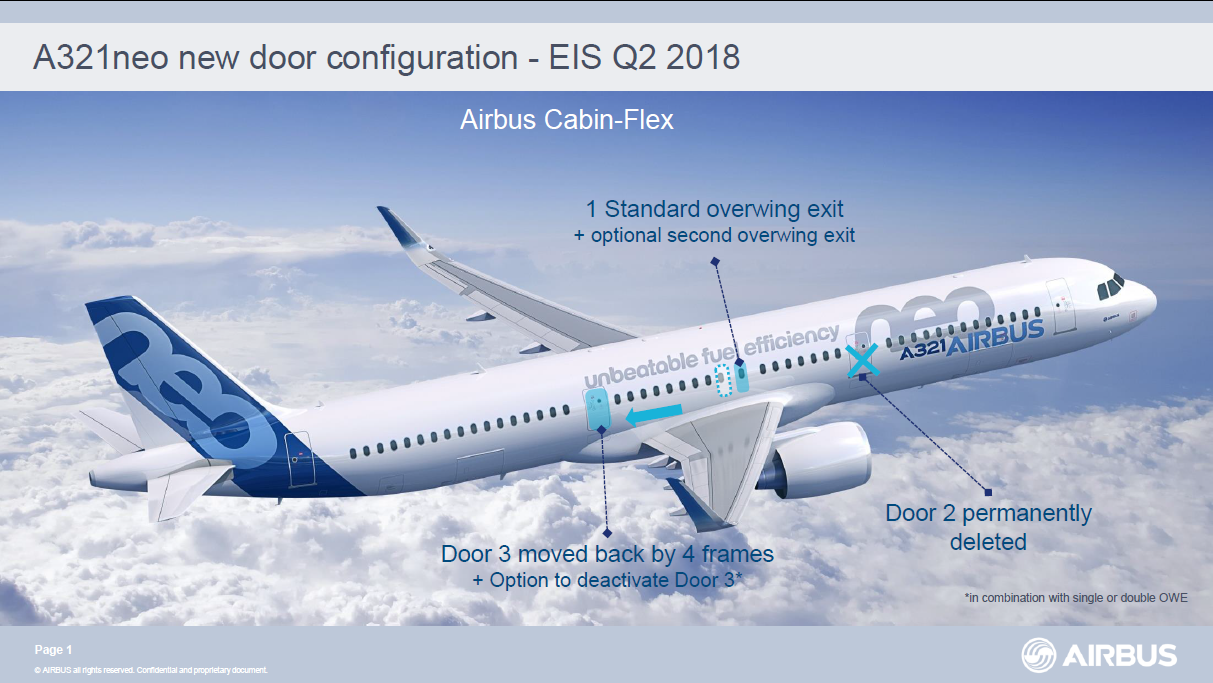
Figure 1. The A321neo with the new Cabin Flex door configuration from 2Q2018 deliveries. Source: Airbus.
Summary:
- The Airbus A321neo is the star in the Airbus lineup. It lacks competition for at least another year, and its two margin-rich variants, the A321LR and XLR, the Boeing 737 MAX 10 can’t compete with once it gets certified.
- There are extra costs, however, to operate these more capable types. It means these shouldn’t be “misused” too much on normal routes.
Airbus 3Q2025: Still on target in 2025 – gliders remain, changes in 2026
By Karl Sinclair
 Oct 30, 2025, © Leeham News: Airbus (AB) CEO Guillaume Faury is still confident that the commercial aircraft maker can hit this year’s target of 820 aircraft deliveries, despite the snarls it is dealing with in the supply chain.
At the end of 1H2025, Airbus had a whopping 60 aircraft sans moteurs. That number dropped to 32 by the end of the third quarter. Faury says that number will hit zero by year-end.
Engine issues at both GE and Safran, which power the workhorse A320neo family under the CFM International joint venture, put deliveries badly behind schedule. It was revealed today during the earnings call that the snags are distributed about 50/50 across the engine OEMs. Typically, Safran provides the LEAP 1A engines to Airbus for delivery to European and other non-US airlines and lessors. GE provides them to Airbus for delivery to US airlines and lessors.
Through the first nine months of 2025, Airbus delivered 507 aircraft to customers, up from 497 over the same period in 2024. That leaves a whopping 313 aircraft to be delivered over the final quarter, to meet the guidance figures.

Guillaume Faury, CEO, Airbur Group. Source: Airbus.
To put it all into context, if Airbus were to hit its future targeted rate increases, for the next three months, it would produce:
- 75/mo for the A320neo family in 2027 = 225 aircraft
- 12/mo for the A220 family in 2026 (guidance changed from 14/mo) = 36 aircraft
- 12/mo for the A350 family in 2028 = 36 aircraft
- 5/mo for the A330 family in 2029 = 15 aircraft
Airbus would deliver 312 jets to customers, one shy of the target.
It must deliver on those rates, now.
Boeing 3Q2025: 777X gets new $4.9bn write off as earnings results prove mixed
By Karl Sinclair
 Oct. 29, 2025, © Leeham News: The Boeing Company (BA) took another charge in the third quarter, to the tune of $4.9bn, on the struggling 777X program–which has yet to deliver a single aircraft to a customer.
Boeing released its 3Q2025 results, following the positive sentiment surrounding the second-quarter results. Despite posting the first positive Free Cash Flow (FCF) since 2023, investors drove shares down nearly 5% by midday.
Boeing’s CEO Kelly Ortberg placed the blame directly on Boeing’s doorstep when he said on the financial network CNBC Wednesday morning, “This is something (the 777X/737 Max certification) that was driven by our inability to get through the certification process as fast as we anticipated.”
 Entry into service (EIS) for the 777X is now expected in 2027, rather than next year. The MAX 7 and MAX 10 are still expected to be certified next year.
Third-quarter losses from operations at Boeing Commercial Aircraft (BCA) totaled $5.353bn, deepening from the 2024 results, when the division lost $4.021bn.
Free Cash Flow was $223m for the quarter and ($2.252bn) for the first nine months of 2025. Operating cash flow was $1.123bn for the quarter, ($266m) for the year, driven by higher commercial deliveries.
Corporate net losses for the quarter totaled $5.339bn, an improvement over 2024 results, when the company lost $6.174bn.
Boeing takes $4.9bn charge in 3Q against 777X; reports slightly improved quarter YOY
Oct. 29, 2025, (c) Leeham News: Boeing takes $4.9bn charge on 777X in 3Q2025 earnings report. Loss from operations: $4.78bn vs $5.76bn year-over-year; net loss $5.34bn vs $6.17bn YOY. Cash flow +$1.1bn vs ($1.34bn) YOY.
More to come shortly….
Boeing sees no new single aisle plane until 2040
Subscription Required
By Scott Hamilton
Oct. 27, 2025, © Leeham News: Recent reports that Boeing is working on a new single-aisle aircraft to replace the 737 MAX and a New Midmarket Airplane (NMA), or a version of it, are fundamentally true but vastly overhyped. At a conference in Prague earlier this month, Boeing’s Darren Hulst put a damper on this speculation, but said only that Boeing was “not close” to launching a new airplane.

Concept of the Boeing New Midmarket Aircraft. Credit: Leeham News.
Boeing hasn’t publicly put any dates on entries into service of its new airplanes, whatever these may be. But internally, Boeing is of the belief that its 737 replacement won’t enter service before 2040.
This doesn’t mean that Boeing’s Product Development unit isn’t working on new airplanes in the background. The company must be ready to respond in case some other OEM introduces a new airplane before then.
Airbus’ CEO Guillaume Faury publicly said several times that it will introduce a replacement for the A320neo in 2038. But there are some within Airbus who dispute this, concluding that new technology needed to justify a new airplane won’t be ready until the 2040 decade.
The driving factor is, of course, new engines. But as LNA’s 13-part series about new airplane technology and 7-part series about new production technologies demonstrate, engines aren’t the only technology needed. However, without significant advances in engine technology, none of the others is sufficient to justify a new airplane.
Safran raises full-year guidance on record LEAP output and booming engine aftermarket
By Tom Batchelor. October 24, 2025, © Leeham News:
A strong civil engine aftermarket and a record number of LEAP deliveries saw Safran achieve a stronger-than-expected set of results for 3Q25 and the first nine months of the year.
 Q3 2025 revenue stood at €7.85 billion ($9.13 billion), up by 18.3% compared to Q3 2024 – and an increase on the €7.59 billion-average Q3 revenue analysts had been expecting.
Revenue for the first nine months of 2025 amounted to €22.62 billion, up 14.9% year-on-year.
As a result, the French aerospace group said on Friday as the results were published that it was raising its full year guidance across all metrics.
Bjorn’s Corner: Faster aircraft development. Part 13. Preliminary Design Review, PDR.

By Bjorn Fehrm and Henry Tam
October 24, 2025, ©. Leeham News: We do a series about ideas on how the long development times for large airliners can be shortened. New projects talk about cutting development time and reaching certification and production faster than previous projects.
The series will discuss the typical development cycles for an FAA Part 25 aircraft, called a transport category aircraft, and what different ideas there are to reduce the development times.
We will use the Gantt plan in Figure 1 as a base for our discussions. Today’s topic, the Preliminary Design Reviews, PDRs, are marked in the chart.
Figure 1. A generic new Part 25 airliner development plan with PDR marked in time. Source: Leeham Co. Click to see better.
MTU Aero Engines revenue and earnings up sharply amid strong OEM business
By Tom Batchelor. October 23, 2025, © Leeham News: Revenue and earnings at MTU Aero Engines grew sharply in the first nine months of 2025, with a strong commercial engine and maintenance business driving profitability at the German-headquartered supplier to Airbus and Boeing.
 Adjusted revenue climbed 19% from €5.3 billion ($6.15 billion) to €6.3 billion, when comparing January-September 2024 to the same period in 2025.
The company’s adjusted operating profit grew by 34% to €995 million (versus €744 million January-September 2024).
CFO Katja Garcia Vila told analysts on Thursday’s earnings call that “positive market trends remain intact”, as she forecast “significant opportunities outweighing existing challenges” for the near term.
Airbus’ A321neo, A321LR or A321XLR?
Subscription required
By Bjorn Fehrm
October 23, 2025, © Leeham News: Airbus’s A321 was launched in November 1988, around the time the original A320 entered service. Delivery to the first A321 customer, Lufthansa, was in January 1994.
The initial sales of the A321 were modest, with deliveries of the variant languishing between one and three aircraft per month for the first ten years. It wasn’t until after the launch of the A320neo/A321neo in 2010 that sales climbed to 10 per month, 20 years after the first delivery. This shall be compared to the 30 per month after another 10 years in 2024.
The smaller A320 was at 24 per month by 2010 and then touched 35 per month in 2019 before it started to cede the market to the A321neo after COVID. Deliveries in 2024 were at 19 per month.
With the A321 dominating Airbus deliveries from 2022, the question is: which variant of the A321 is suitable for what routes? Does a “misuse” of an A321LR or XLR on short to medium routes mean an operational cost loss compared to a standard A321neo?
We look into the different A321neo variants and compare their capacities and operational costs in this series.
Summary:
- The Airbus A321 started life with low sales, the market preferring the smaller A319 and A320. One of the reasons was the large jump in capacity between the A320 and A321, more than 40 seats.
- By the introduction of the A320neo series, the market had developed to higher capacities. After COVID, the A321neo took over as the dominant A320 range variant.